Draft Four: The Bravest Souls
The letters are back!


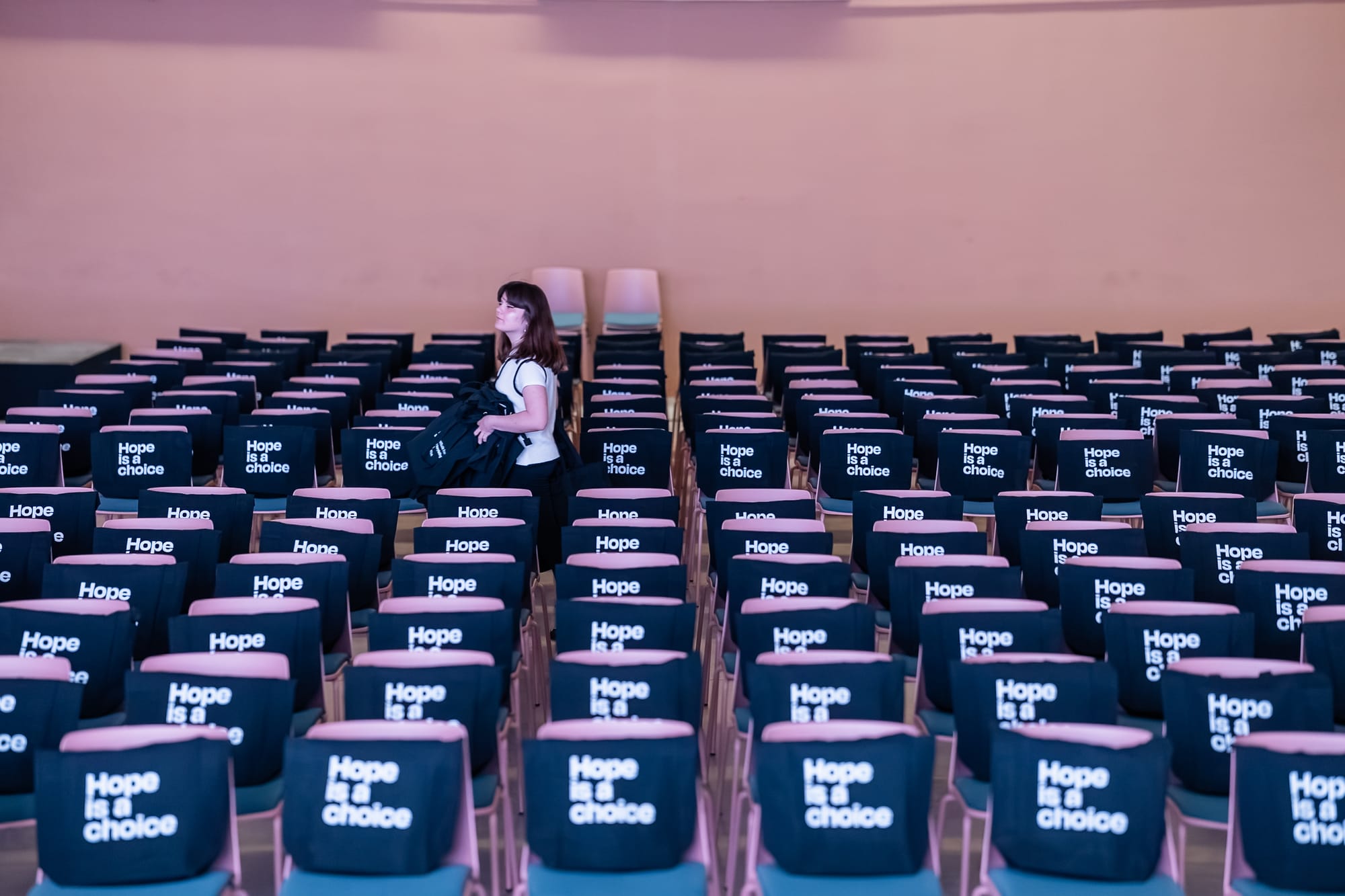
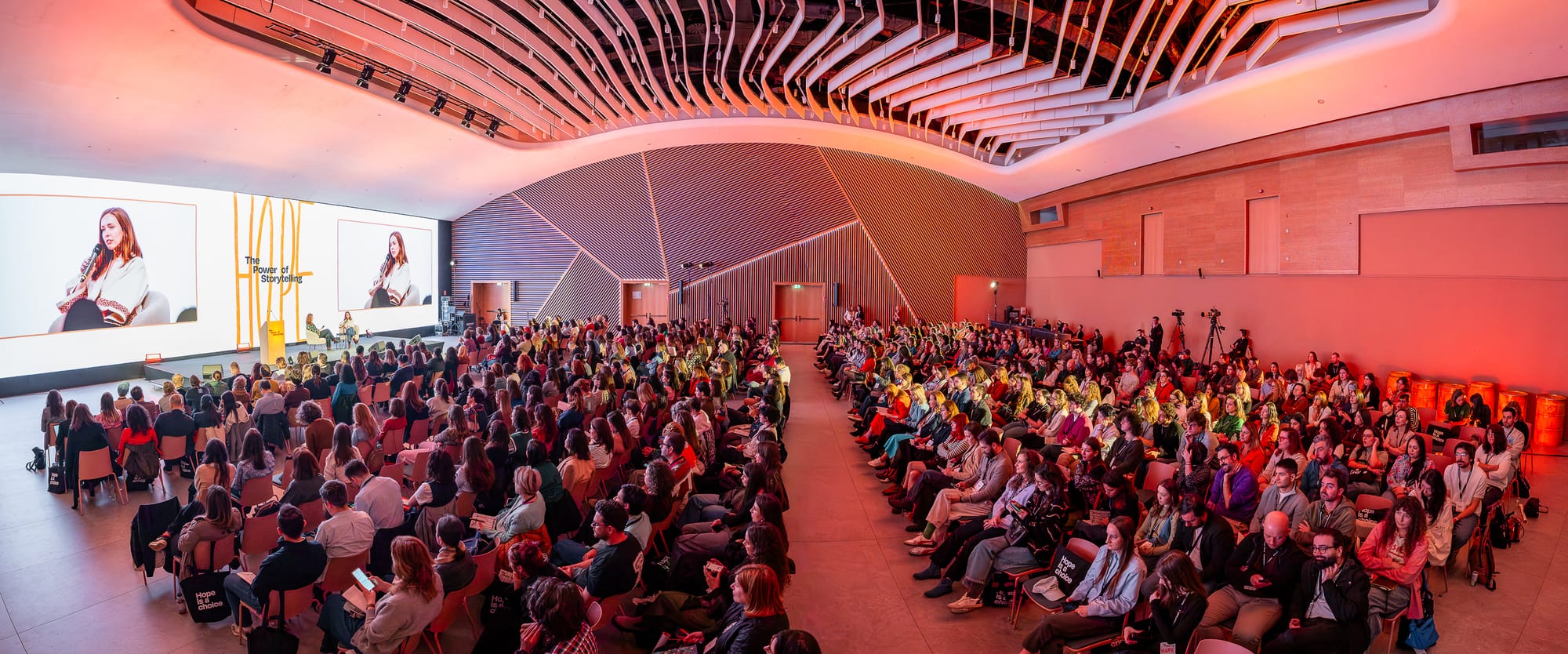
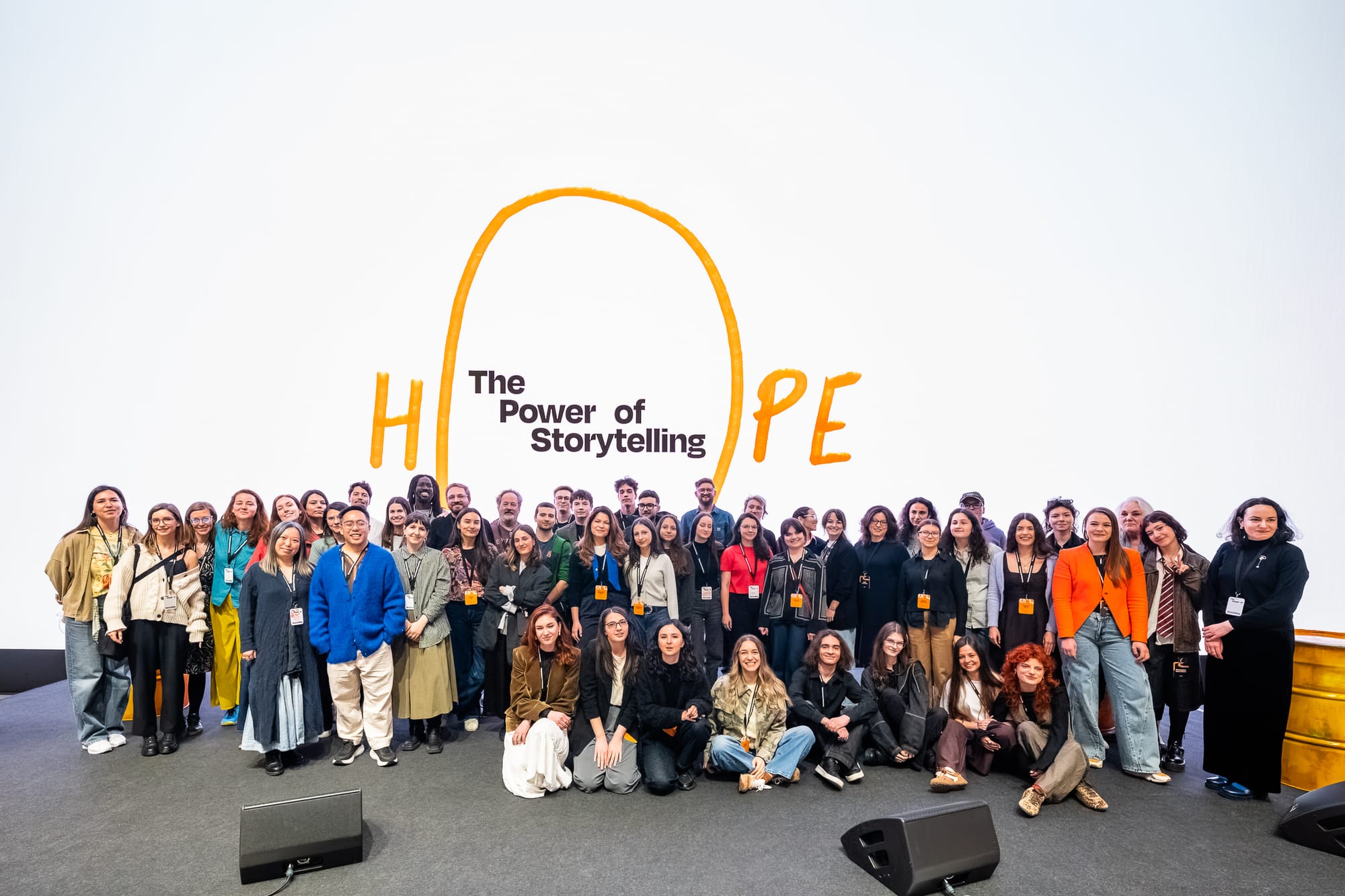
The room was packed – we counted 543 seats in the morning, all carrying a black tote bag with Hope is a Choice printed on it. It was time. The lights went down, and the room-length screen switched to read The Power of Storytelling in white, on a dark gray background. As the chatter quieted, Maria (who performs as Krrysopher) and Daria walked on stage, took their seats, hands on the keyboard, fingers on the strings. The first notes, notes that would echo through the weekend, began.
“The future grows dark”, Krrysopher sings on The Bravest Souls, “as bodies grow cold / will we find a way of this place / of this cage / can we breathe / with this violence up to our necks?”
I gasped when I first heard this song, which she wrote for our event. It carried one of the big questions: engulfed in violence, suffocated, how can we get out? Then another one: can stories shine some light in this darkness? And the toughest one maybe: does choosing hope play a role?
Hope. Let’s start here.
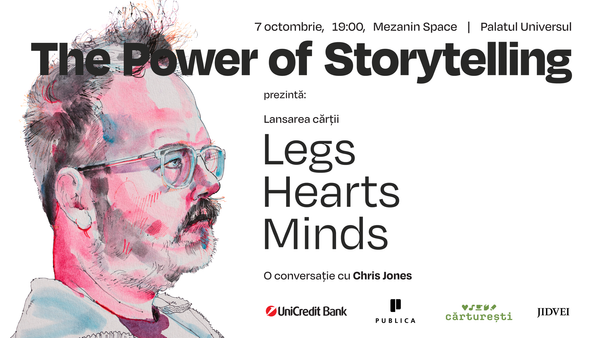
It was last year, towards the end of our anniversary edition, that writer and journalist Chris Jones told the story of his mom’s passing, and how his love of football and a small underdog Premier League team guided him through the pain. (His book Legs, Hearts, Minds: Loss and Its Remedies comes out in June; a Romanian translation will follow soon after).
“Your heart can lead your mind, but your mind can also lead your heart”, Chris said. “Hope isn’t a feeling. Hope is a choice.”
Participants heard the last part loud and clear: it became one of the catchphrases of last year’s edition. The more we thought about it, the more it seemed like the right choice for 2026.
A year and change ago, Romania’s presidential elections were cancelled in a blatant disregard of democratic process. We briefly forgot about that because, thankfully, the far right didn’t win. But neither did transparency. Or empathy. Or listening. To fix the highest inflation in Europe and a terrible deficit, the new government started looking for money – it didn’t plan to get it by improving collection from fraudulent powerful people or interest groups, for example. No, it started cutting into social services for mothers, students, people with disabilities.
The president we eventually chose is by no means a savior – his decisions over the past year show him disconnected from the travails of ordinary citizens, disrespectful of honest journalists, and enamored with his new found access to secret service briefings and shadow-room dealing.
Recent polls show that if elections were held tomorrow the far right we supposedly defeated would win easily. And, at this rate, it’ll take a miracle for them not to win in 2028.
Not too long ago, we allowed the US to use Romanian bases to refuel in its now stalled assault on Iran, Trump’s latest maniacal impulse. Remember that this year alone Trump presided over the killing of American citizens in the streets, and the removal of the Venezuelan president as if it was a game. Joining the US in Iran and rampaging through other Middle Eastern countries is Israel, which has obliterated Gaza in the past two and a half years, committing innumerable war crimes amounting to genocide.
And yes, since this is coming from Bucharest, there is still a war fought across the border, where Russia continues an illegal and unjust invasion of Ukraine.
Need I go on? That was just politics, but there is also climate change, legitimate worries about our AI-driven future, a general sense of disconnection, and this feeling we’re just six-sevening through our days.
If you’d ask famous Romanian philosopher Emil Cioran, he’d say: “hope is a slave’s virtue”.
In a way, it makes sense, right? The world isn’t doing well, and the idea of hope seems ridiculous.
When reading up on the theme of hope, one quickly stumbles upon Pandora – yes, the one of Greek mythology fame. Pandora has a box (turns out it was most likely a jar) with a lot of bad stuff locked inside. Because she can’t help it, she opens it, unleashing all sorts of evils: disease, sickness, death.
Pandora eventually shuts it, trapping one last thing inside: hope. Depending on which side of the debate you fall on, the hope left in the jar is either the one antidote we have against evil, or the one evil us mortals were spared from. Nietzsche, for example, thought hope belonged among the horrors: “It is in truth the worst of all evils, because it protracts the torment of men.” (Cioran is in this camp, too.)
Through this lens, hope is the realm of the delusional, or the privilege of those observing destruction and despair from the sidelines. The main charge against hope is that it encourages passivity. That you wait for external forces to shape your life, or the world. That hoping is irrational, leading one to be less free, enslaved by foolish expectations.
But there is no right or wrong definition, Lars Svendsen writes in A Philosophy of Hope. “For some, to hope is to become passive, to stop believing that you can accomplish something yourself and instead indulge in a belief that external forces will ensure things go as you wish.” He goes on: “For others, hope is active and linked to creating possibilities, seen in an as yet undetermined future”. And, he says, “although Cioran is right, that hope can make you passive, nothing can make you more passive than hopelessness.”
That’s the space I’m interested in, and the where this edition of The Power of Storytelling sprang from: less about hope as waiting, and more about hope as acting. Or, as Krrysopher sang on in her song: “Can we love / can we see / that hope is the power to stand up”.
This means we understand the word as the possibility that, even under the worst of circumstances, actions can change the course of things, and change them for the better. This way of looking at hope is inspired by many writers and thinkers, some of whom we had on stage.
The American writer Rebecca Solnit took on the topic in Hope in the Dark, a book published 20 years ago that remains relevant to this day. “We don’t know what is going to happen, or how, or when, and that very uncertainty is the space of hope”, she writes. “Optimists think it will all be fine without our involvement; pessimists take the opposite position; both excuse themselves from acting. It’s the belief that what we do matters even though how and when it may matter, who and what it may impact, are not things we can know beforehand.”
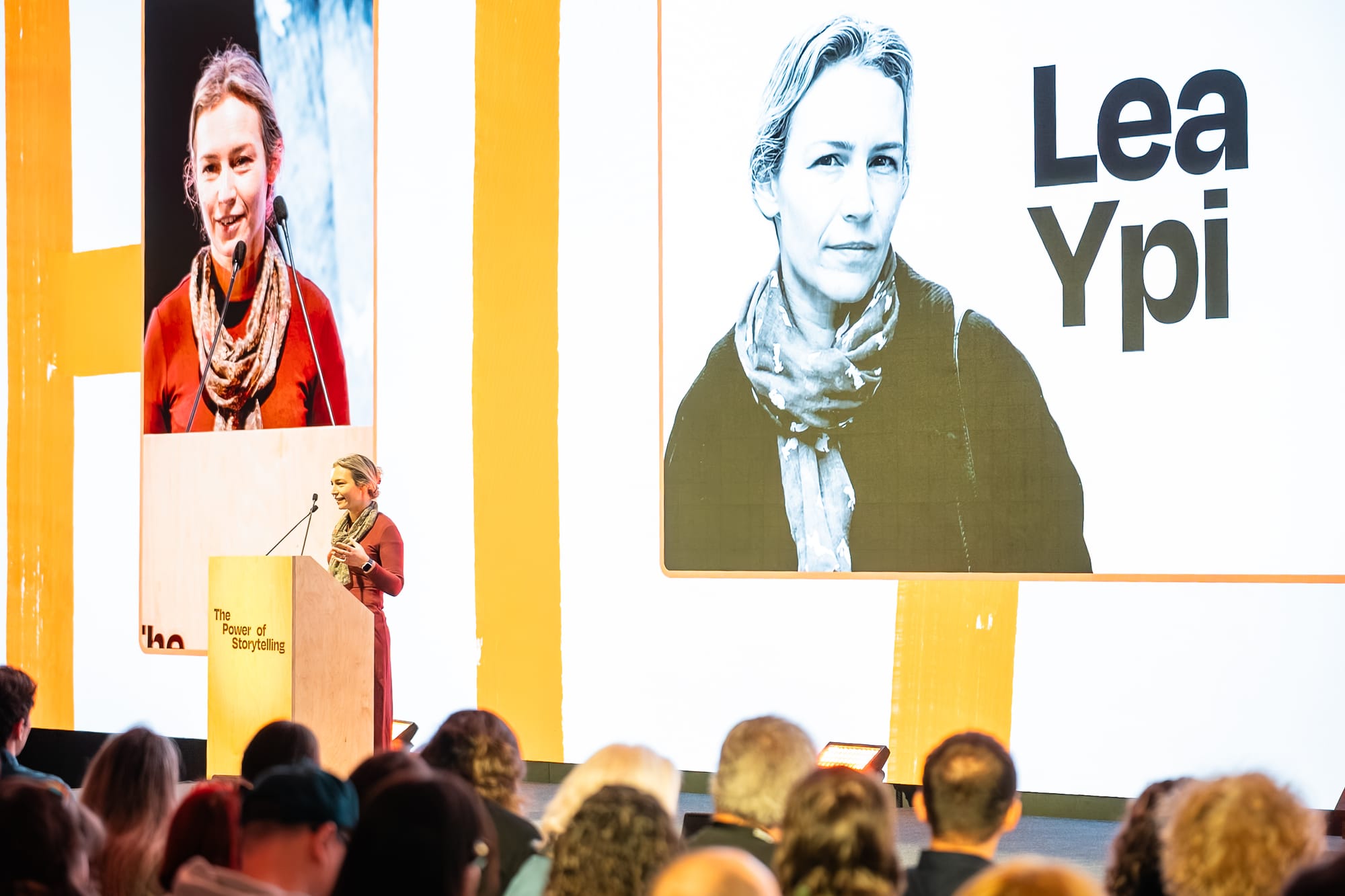
To our 2026 speaker, writer Lea Ypi, hope is a fight to retain agency, “a way of reconciling larger than human forces that lead to inaction with the necessity of remaining centered on the individual”. She adds in an interview with The New Institute: “Hope is an attitude, somewhere between a desire and a belief; a desire for a certain outcome and a belief that the outcome will be favorable. Hope in the individual is a kind of passion.”
In A Philosophy of Hope, which I mentioned above, Svendsen also distinguishes hoping from simply wishing for something. “I can only hope for something that I perceive to be possible; wishing does not have that limitation”, he writes. “A person who really hopes will act, reflect and express themselves differently to a person who only wishes. A person who hopes is moving towards the goal. Hope will often be linked to one’s own actions: if I do A, I hope that B happens.”
“[Hope] is a searching movement”, writes philosopher Byung-Chul Han in The Spirit of Hope. Unlike optimism, it’s convinced of the outcome, and it takes into account our fears. And despite all odds, it moves us forward. “The spirit of hope is likewise an onward striding. It keeps working away amid darkness. There is no light without darkness.”
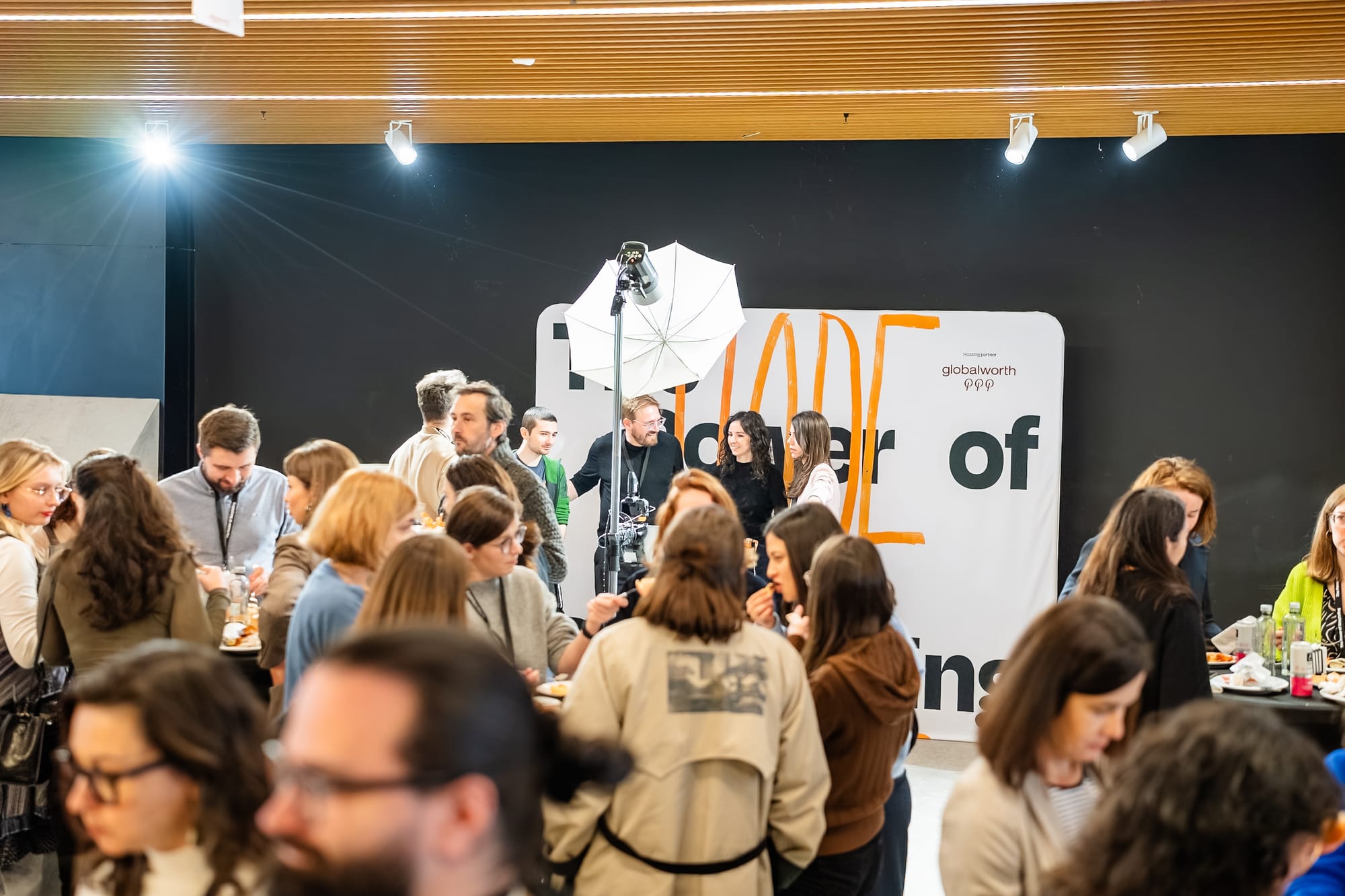
It’s hard to tell the story of what happened in our room in Bucharest over the next couple of days as 15 speakers took the stage, followed by performances from artists, journalists, activists. I can quote numerous from superlatives from participants, speakers, or even our team. But it would sound like bragging without you having the context of being there, feeling it.
From the outside it looks like we just hosted a few hundred people in a fancy venue, with a huge LED screen, with a tote bag of goodies, offered them Boiler’s smooth flat whites, had good food, wine, and, of course, the chance to be inspired by world-class writers, journalists, and artists.
Yet it’s strange to experience belonging in a room with almost 600 others, to feel safe, and seen. The blend of people on stage, and in the audience, plus the vulnerability and trust that are created here are rare. The Power of Storytelling is a place of hope, which is why there is often laughing, and, just as often, crying. We try hard to make this happen, but creating the container is never a guarantee – it’s the people that fill it.
To me, doing this conference remains a privilege. And I said as much on stage. It’s a small luxury. A gift. An escape before we go back out there, in the real world, and face all that darkness. This is where stories come in – they remind you that you’re not alone, they offer inspiration, solutions, belonging, they create bonds and solidarity.
That’s the bet, that’s why we do this: so that people can find their way back to themselves or to another, and, despite of everything, stand up and make something.
Just this week, the world offered the perfect metaphor for the choice we can make. Trump, in one of his unhinged social media outings, had this to say about Iran: “A whole civilization will die tonight, never to be brought back again. I don’t want that to happen, but it probably will.”
This is calling for genocide of a millennia-old Persian civilization, currently a country of 90 million people. The casualness and callousness of this statement is astounding and tells one story of the world: America first, bitch. In this world of ours, we are all fighting for supremacy, and resources. There is no collaboration, no trust, only the occasional deal, followed by the necessary betrayal. The strong prey on the weak. Deal with it.
In the very same galaxy, but far far away, the farthest we’ve ever flown, just after clearing the dark side of the Moon where communications were impossible for 40 minutes, one of the Artemis II astronauts, Christina Koch, came on the radio: “It is so great to hear from Earth again”, she said. And then she followed with a completely different story of who we are, who we could be, and what we could choose, day after day:
“We will explore. We will build ships. We will visit again. We will construct science outposts. We will drive rovers. We will do radio astronomy. We will found companies. We will bolster industry. We will inspire but, ultimately, we will always choose Earth. We will always choose each other.”
What we think, how we act, is down to this fundamental choice of what we believe about the world and human nature: is it war or is it wonder? Do we lie or do we love? Do we act fueled by hate, or do we act fueled by hope?
We’re imperfect, and we’ll err. We’ll lie, maybe we’ll even hate occasionally. But we can course-correct.
To push for awareness and course-correction is part of why we restarted The Power of Storytelling. Choose one thing that you feel makes a difference, and act – charity work, activism, campaigning, care-giving, movement-building, journalism, art, game design, literature etc. We’ll be that occasional pit stop. where you can rest, lick your wounds, unload some of the pessimist and cynicism that we invariably bring on board, and take off again.
“I’ll take the step towards the light”, Krrysopher reminds us in her song. “Cause hope is the courage to stand up / cause they will never chance no / nothing changes if we don’t / stand tall / and build it from the ground up / a world that be all that we hoped / the bravest souls are made out of hope.”
NOTES:
- My gratitude to everyone on our team, our volunteers, and friends: you are what made magic possible for all participants and speakers.
- This essay is adapted from things I wrote about hope for the conference, as well as things I said on stage.
- Keynote talks from the conference will follow soon, and I’ll go through a few here when they’re published. In the meantime, if you want something more practical check out our takeaways from Day 1 and Day 2.
- I highly recommend all books on hope I mentioned above.
- Also – it’s been three months since the last letter. I needed this break both to have space to finish organizing our event, but also to recharge. If it’s something that has been consistent for me, it’s my desire to explore the intersection of storytelling, hope, empathy, and change. So I’ll continue on this route; any input is welcome.