Draft Four: The stories of others. Plus: NL changes
The state of the discourse and the future of these letters.

Edi is a young social worker in Western Romania. She has a second part-time job doing social media, and is also getting a second degree, in law, because her dream is to become a probation officer. All total, she makes around 3.600 lei per month (700+ Euros), more than the current national minimum wage (around 2.500 lei), but less than the estimated decent monthly income for one person (around 4.300 lei).
Her car expenses alone eat up half her income, and she needs it to commute to her social work job, which is outside the city she lives in. She works mainly with children from poor families but also helps parents access social benefits and navigate the system. Still, if she didn’t live with her partner and his parents, she’d be broke.
“I work so that I end up in the red, by every possible measure”, Edi told Andreea in our fifth and penultimate episode of Prea Sărac.
“On the level of the soul, morally, my work is excellent. What I do is deeply fulfilling, deeply moral – genuinely beautiful. I’m educating kids, shaping them for tomorrow.
People who will work, live in this community, maybe start families or maybe not, who might do harm or might not – ideally not. The idea is for them to grow up remembering that there are things you’re not allowed to do: immoral things, illegal things, illegitimate things in general.
But if I leave now, what should I expect from them? That’s why I say I’ll regret it – because I keep thinking about the aftermath. Always the aftermath: what happens then? Where do they go if I’m no longer there?”
I don’t know about you, but this broke me.
What Edi is saying is that she believes she won’t be able to do this for much longer because she can’t afford it. She grew up in poverty, sidestepped her family’s ploy to marry her off young, had a personal journey that made her want to give back, but she is paying out of her own pocked to help.
Prea Sărac #5: Poverty is line a pulsing nerve ending
Young people like Edi are the teachers and social workers we need. And the bureaucracy they join couldn’t care less about their ideals – they get paid a meager wage, and get no resources. The authorities couldn’t afford Secret Santa at her center, so she and her colleagues made do with some previous donations, because they didn’t want the kids to go home empty handed for Christmas. They wouldn’t get much from their families anyways.
Our systems rely on the goodwill and ideals of their largely anonymous employees. The Edis: doctors, nurses, teachers, judges, bureaucrats, people with an internal moral compass and a capacity for empathy that many of us are losing.
But they are at a limit. And guess who our private enterprise-loving government targets most with austerity measures?
There is some truth that the system is rife with corruption and graft, but we’re throwing the baby out with the bathwater. Edi herself sees the unfairness and corruption in the system; the mayor has nice cars, and his friends are doing well, but the vulnerable folk? Forget it.
I asked for money for gifts [for the kids], right? We don’t have money for gifts [they told me], okay? But somehow, we have money for a beer festival, a bread festival, some festival or another – whatever the hell – but we don’t have money for gifts.
We don’t have money for your stuff, the things you need at the day center to educate and raise these kids. They don’t have money for Play-Doh. Literally, no money for our Play-Doh. And I think that’s what frustrates me the most.
You don’t solve a lack of care with more lack of care. Corrupt bureaucracies will always find a way around any rules. By threatening to punish people who supposedly abuse the system, you’re punishing more of those that don’t.
Edi wants to be a probation officer – we need those. But because there is no money, there are no job openings. Simultaneously, the minister of justice is denying he plagiarized most of his PhD thesis, but his government colleagues aren’t going after him. The powerful protect each other. And what happens when they do is that the Edis of the world lose faith – they move on from their dream of a life of service, to one less fulfilling, but maybe more dignified.
This is how bitter Edi is about how the decks are stacked against her:
I went to Timișoara thinking of meritocracy – idealistic me: I’m the new generation, the one that’s going to change everything, tear it all down. That I’m going to help this country heal.
Meanwhile, my generation – look, that girl, who was at the embassy in New York, our age – and at the end of the day, what she’s got is thanks to her dad. Or all the mayors’ kids just roaming around city hall. I see it up close, at my university – my former university –where the mayor’s daughter sits there, hosts all the shows, works “something” in city hall, leaves early, takes it easy, and everything’s fine.
That’s how it works. That’s the hierarchy. That’s the reality in this country.
*
Go listen to Edi herself in the episode – she’s more persuasive than I could ever be, but I’m sharing her story for a reason. Being next to Andreea on this journey, I felt a strong need to have more of other people’s stories in the foreground.
We live in a me-me-me age, a time of takes and opinions and identity virtue signaling. And it’s fine – none of us can stop the algos from delivering this, nor the AIs from churning out slop. As we do more and more opining – on realities and facts that are second or third hand information – we are farther and farther from people’s lived experiences.
And we need the experiences and stories of other people to understand our own.
Which brings me to a tension I’ve had with my Sunday letters to you.
*
I came with trepidation to writing this weekend. Here’s the truest and most direct thing I can say: it’s been 3 years since I’ve started sending these letters, and I don’t know if I should keep doing it. Certainly not as I have.
On January 15, 2023, I sent a first Draft Four to 41 people – my age at the time. I was motivated to write a letter a week for a year as I put my life back together. It was a terrific experience of journaling in public, of discipline, of rediscovering writing.
But things have changed.
My personal life is steadier, more purposeful once again. And it’s not that I can’t write about that – it’s that I don’t believe it’s a useful story anymore.
The world has changed, too. I have no take on Venezuela, the future of Gaza, ICE, Greenland, the Romanian judicial system, or the flavor of the week social media beef. Or more aptly put, I have opinions, but I don’t want to add to the collective noise.
*
Something changed in the past couple of years, and I don’t think it’s just me.
We have more spaces than before to share ideas and be seen. When I started writing on the internet 30 years ago, being read by 3 people was a miracle. Now it’s considered a failure. We consider it a right to speak, to speak over others, to speak about what others speak. We live in the noise.
I shout to be heard by a small number of people that want to hear me. But I shout louder, to drown out others who want your attention, or to drown out those who think I should just shut up, so they are shouting themselves.
The discourse is centering ourselves too much. In the bigger scheme of things, I know I don’t matter. It’s a thought that’s always given me comfort. But we live thinking it’s not so: thinking we should say something, worrying if it’s the right thing, then worrying about reach and engagement. Sharing is despairing.
I’ve seen folks – mostly closer to my age, but also Gen Zs – who opt out. Who just quit social media or the discourse: not because there isn’t anything of value (there is, there always is – even on Facebook), but because it’s messing with thinking and being in the world.
*
One reason I quit Substack in September was because it had become the attention Olympics. The days where it was a platform that allowed for email delivery and out of stream discourse are long gone: now creators are pushed on you, people compete for visibility, because, at the end of the day, they compete for relevance and cash.
These letters are going out on Ghost, where there is no app you need to use to also share what you just wrote. Sure, there are no ❤️ either. Some days, I miss them. Maybe because in my growing worry about adding to the discourse they helped answer the tough questions: Did this mean anything to anyone? Was it useful?
That’s the important question. I like writing, like thinking aloud while typing, like the challenge of the weekend thinking exercise. But I don’t want to do it for myself – I have my journal for that. If it isn’t useful, it’s waste, it’s slop.
ChatGPT came out just a couple of months before the first Draft Four went out. Today, it and other LLMs, are churning out immense amounts of text. Emails, essays, resumes, summaries, contest entry – so much AI. A lot of viral content is AI. There isn’t a week that goes by without my father sending me something and adding: “This is probably AI, but it makes a great point”.
*
This is not written to be a pity party, or to elicit validation. If you’ve read Draft Four last year, maybe these thoughts come as no surprise.
I don’t think the world needs less conversation, or stories, or writing, or creativity. I just think it needs less me-opining-about-the-world kind of content, and more complicated stories. More reporting, more other-focused work, more energy put into how you can make others feel or how you can be of service.
What I need is more stories like the one about Edi. What I need is to understand the world. Nothing is stopping me from doing that or making space for that, I know.
But it means making a change and ditching the structure and schedule Draft Four exists on: no more twice a month Sunday letters, and more like the occasional post when I feel there is something worth sharing.
It wasn’t my plan to write all this today, but in the spirit of transparency that I try to write from, I let the tension surface. I’ve been feeling more and more that what I’m offering every other Sunday is more like slop than service. It’s also why I stopped asking you for money. Maybe it’s because the letters feel rushed – or more rushed than they were when I started. It’s true I was doing less back then, which, in a way, is a sign that Draft Four did accompany me into a new period, one in which I can step more into the background, where I’ve always felt better.
I’m grateful for all the support, encouragement and comments. This is not goodbye. But it is a moment of lowering expectations, of decoupling the writing from an expected schedule, of more intentional and mindful and hopefully useful creativity. Maybe this means I’ll read even more and share what’s good with you. Maybe it means I’ll experiment with formats that center the experiences of others. Maybe it means I’ll use this as a platform for the occasional essay.
What it certainly means is that I want more stories like Edi’s. More being there. More helping us connect to the lived lives of the people around us. For me, these are hope as a service.
Stick around, and we’ll find out together.
*
It’s only been a few days since Edi’s story came out, and some people wrote to us saying they wanted to support her. Yes, give her money, but maybe also find ways to support the center. It’s always touching when others are moved by a story to take action – that’s not why we tell them, but, unconsciously, it’s why we read them, or listen to them.
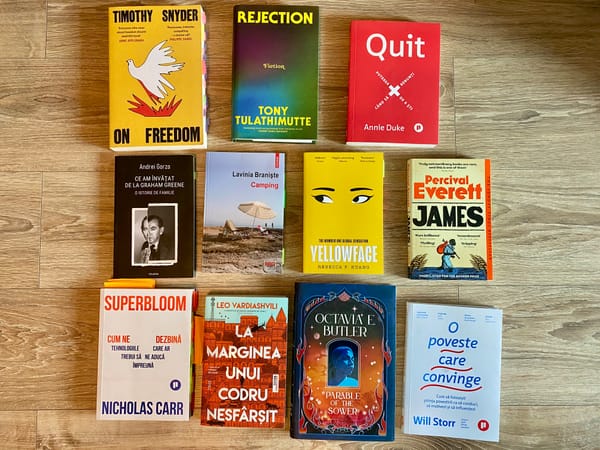
Partly to know we are not alone, partly to learn how to navigate obstacles, partly to learn how to live better. Many stories of others have given me that over the years. In early 2026, with the world as it is, it was Edi’s.
SIDE DISH:
One small but mighty reminder. The Power of Storytelling line-up is now complete (apart from some surprises), and all the available seats are now for sale. This is the best group of storytellers to learn from – especially if what you want is to tell better and more complex stories about the world, no matter the format and the audience. Grab a spot on Eventbook.