Draft Four: The Year in Books
20 reads that shaped my year.

Before we begin, a Christmas gift recommendation: grab a spot for you and a friend at our March edition of The Power of Storytelling. Our gathering will be sold out by February, and you won’t want to miss this edition – we are tackling the theme of hope with a terrific line-up of writers, journalists, activists, and artists from all over the world. We’ll announce everyone through January, but it already includes phenomenal authors such as Lea Ypi, Nathan Thrall, Lana Bastašić, and many others. See you there, I hope!
Regular readers know I collect recommendations in “side dishes” at the end of most emails. This year I’m devoting the first of two December wrap-up letters to books alone.
What follows is a list of 20 books, in no particular order, that helped shape my thinking over the past year. It was not a great year for reading or focusing, and my winter stack is intimidating, so more recommendations will follow early in 2026.
FYI: The links take you to Cărturești, a Romanian bookstore chain. I’m linking to them for support; I have no benefit/commission. For convenience – or even price – you might want to make a different choice).
If you give anything here a try and it works for you, let me know.
📗 Perfection, by Vicenzo Latronico. An expat couple in Berlin always chooses the best decorations, the perfect fonts, the appropriate restaurants; so why isn’t it enough? At 120 pages this is a slim book that packs a punch in its critique of the Monocle-millennial-lifestyle, one that is perfectly curated, yet never quite satisfying. Even though he questions their vacuousness, Latronico is gentle with his characters because, as he puts it, they are also him. And many of us, too.
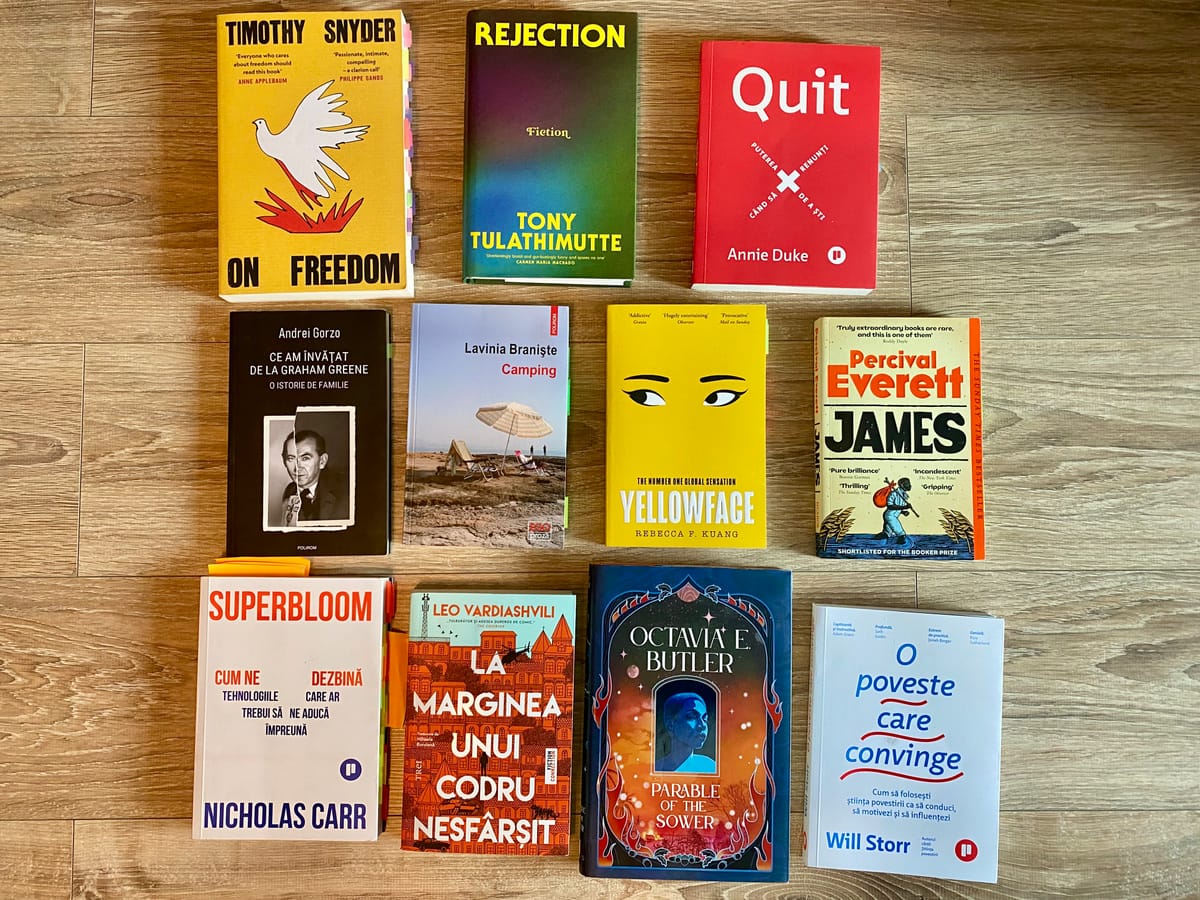
📗 James, by Percival Everett. This fantastic Pulitzer-prize winning novel retells the story you know from Huck Finn from the perspective of Jim (James), the runaway slave. It’s a book about coming into being through taking over the narrative, as Jim does when he gets a hold of a pencil and starts telling his own story. (Also in 🇷🇴).
📗 Catch the Rabbit, by Lana Bastašić. Originally published in 2018, it was translated by Lana herself and won a European Union Prize for Literature. It’s a novel about friendship, but also about loss, identity, and the complicated connections people in this part of Europe have with the homelands that refuse to let go. (Also in 🇷🇴).
📗 On Freedom, by Timothy Snyder. In his beautiful book-length meditation, Snyder lays out five conditions needed for freedom: Sovereignty (the ability to see others as free, too), unpredictability (being able to act in ways no one can fully anticipate), mobility (people must be able to move – across borders, classes, and opportunities), factuality (lies serve those who want to control, not liberate), and solidarity (freedom is sustained through mutual care, not isolation.) “Freedom is not negative, not a matter of our breaking what is around us. Freedom is not us against the world but us within the world, knowing it and changing it.” (Also in 🇷🇴)
📗 One Day Everyone Will Have Always Been Against This, by Omar El Akkad. A critique of our impassivity at the suffering of Palestinians in Gaza. Yes, we look away also because we have our own problems to worry about, our own fears, our own decaying communities and democracies. But in Gaza, for the most part of the Israeli siege, a child was killed every 45 minutes; that’s more than 20.000 since October 2023.
📗 Meditations for Mortals, by Oliver Burkeman. Read as prescribed: one chapter a day, for a month. It’s an ode to imperfectionism, an acknowledgement our time is finite, our capacity for control is finite, and our ability to do things is finite. It is because and not in spite of this finitude that we should act in the world. (Also in 🇷🇴).
📗 Rose/House, by Arkady Martine. A novella-length Sci-Fi thriller about architecture, the climate crisis, and the AIs we will live with. It’s one of those afternoon reads that makes you go: “What the heck was that?!”
📗 Hard by a Great Forest, by Leo Vardiashvili. If you’re looking for an adventure read, pick this one about a young Georgian returning to his native Tbilisi to find his recently disappeared father and brother, and the country he once called home. (Also in 🇷🇴).
📗 Ce am învățat de la Graham Greene (What I Learned from Graham Greene), by Andrei Gorzo. The film critic adamantly writes against the family memoir as a form of healing, but I don’t think he’ll mind if that’s the effect it had on this reader. A beautiful story about a father and son bonding over spy stories in the troubled Romania of the 1990s.
📗 Parable of the Sower, by Octavia Butler. This classic Sci-Fi story starts in 2024, with fires raging across California, people locking themselves in gated communities to defend from predators and zombie-like poor people, and a “Make America Great Again” president turning the country over to private companies to run water supplies, even company towns. Where does one find hope in such a world? (Also in 🇷🇴, but harder to find).
📗 Parable of the Talents, by Octavia Butler. The follow-up to Sower tackles a different story. The seeds have sprouted, the march of lawless authoritarians is slowing down, a new center of power is emerging. Will it reshape the world and its unjust structures, or just mold it differently? Can we change life here on Earth, or is our only chance to take off for the stars? (Also in 🇷🇴, but harder to find.)
📗 Doppelganger, by Naomi Klein. We’re surrounded by forms self-absorbed alienation. How far this alienation can go is largely the plot of a book that explores both Klein’s relationship with a writer people often confuse her with, but also our deeper relationship with our mirror selves, or the mirror worlds that politics and technology and pandemic-isolation have shaped. Solidarity, mutual aid, togetherness, teams, require presence, and listening, and sacrifice.
📗 Yellowface, by Rebecca F. Kuang. What happens when a young writer decides to appropriate her more famous friend’s unpublished novel? A page-turner about loneliness, racism, and discrimination in publishing, one that is wickedly funny.
📗 Rejection, by Tony Tulathimutte. I can’t do justice to this book of loosely linked tales. It’s filthy, it’s funny, it’s like the inside of a brain soaked in the most obscure and dark puddles of the internet, coming to terms with the more complicated nuances of human relationships.
📗 Camping, by Lavinia Braniște. Lavinia is my favorite Romanian novelist and her most recent book tell the story of Sofia, a Romanian immigrant in Spain who is nearing retirement. She’s been gone 20+ years, driven away by a society that made her feel irrelevant. Will anything be different if she came back? Was exile a source of newfound power or just a diversion from the pain of a wound that will never really close?
📗 Quit, by Annie Duke. Duke reminds us that we live in societies that don’t reward quitting – on the contrary, quitting is giving up, and we only praise those that stay the course. But some of those who stay the course – people or initiatives – die. We stay in terrible jobs, and toxic relationships. We persist with an endeavor when we shouldn’t, our biases holding us hostage. We should quit more. And we should quit sooner. (Also in 🇷🇴).
📗 Ultra Marin, by Dragoș Costache. A sci-fi dystopia about a man from Southern Romania that ends up working on an AI-powered vessel in the South Pacific, sometime in the not-so-distant future. Don’t laugh at the premise – if we don’t renegotiate our relationship with AI, it’s more than likely we’ll end up here.
📗 Empire of AI, by Karen Hao. Open AI and other AI companies behave like empires. They plunder, steal, exploit, all in the name of progress. Hao has been covering the company for years, and this tale is one that takes you from the conflicts inside it, to the people doing AI-training in the Global South for very little pay, and plenty of trauma. Let’s not even mention energy consumption.
📗 Superbloom: How Technologies of Connection Tear Us Apart, by Nicholas Carr. 15 years ago Carr wrote about how the internet rewired our brains. (He was right). This time, he’s going farther, arguing that modern comms technologies – from the telegraph onwards – promised peace and freedom, but mostly delivered social fragmentation and misunderstanding, overwhelming human psychology with ever-increasing efficiency and stimulation. His main point is that by removing all friction – infinite scrolls, putting the whole world in our pocket, building machines that can communicate in our stead – we’re leaving ourselves vulnerable to breaking with reality. “People routinely say they worry about how the internet distracts them from their surroundings. But their behavior suggests the reverse is probably closer to the truth. Reality has become a distraction from media.” (Also in 🇷🇴).
📗 A Story is a Deal, by Will Storr. Storr also wrote the wonderful The Science of Storytelling, where he breaks down the mechanisms and techniques of story. In A Story is a Deal he explains what stories do to the brain and why that matters for business and leadership. As he puts it: “Story is what we do. Story is who we are. Story is human life itself.” (Also in 🇷🇴).