Draft Four: What We Can Know
On living through the present.

As I write this, on the first Saturday of 2026, I must confess I feel a wrapped fatigue like never before. So many end of the year list, charts, dashboards, carousels that I fear adding to the noise. In truth, all I want to say is this, and it’s bland: “one year ends, another starts, and we should be grateful to be alive to witness them”.
Of course I looked back on 2025, too.
What I found was neither bad, nor good. It was… life. Some of it bad with terrible sprinkled here and there, some of it good mixed in with the occasional miracle. I think it’s the abundance of lists and reviews and qualifiers (and maybe my age) that pushes me away from trying to wrap it neatly. Or maybe that’s the actual (boring) wrap: that it was all-encompassing, that it had everything.
Factually, when re-reading my daily notes, I was surprised to rediscover how tough the first few months were, as I dealt with health challenges (my own and my family’s), including a doctor pointing out that my cholesterol levels were “deadly”, the kind of thing that can make a perfectionist proud. On the flip side, I was grateful to have taken more vacations (credit to my partner for reminding me they work), including some that will stay with me forever.
I went into the winter break with bad memories of the last quarter of the year, and I could see why: I over-extended myself, and it wasn’t solely a question of volume. In many ways I strayed from my 2025 intention of focusing on my own projects, and was stuck juggling overlapping freelance assignments (which I took on, partly, for fear of losing financial safety). But it was also towards the end of the year that I successfully eliminated one of the biggest stressors of my life: I left an apartment that for a little over two years had felt as transitory as an Airbnb.
2025 started with a word of intention: embody, which to me described how ideas, values, and experimentation come together to transform something into reality – essentially, living through things to make them real.
And here is where our mind plays tricks: did you embody enough? Did you bring enough things into reality? Did experimentation result in a lack of focus? Thanks brain, nice of you to look out for me, but I’ve decided I’m content with what that came to be. Simply adding to the aforementioned move the return of The Power of Storytelling, plus helping a podcast to life brings the total to “good enough”.
I do understand much of the unease of many who say we closed 2025 exhausted. And that’s not just 2025 – that was 2024, 2023 etc. We are living too many simultaneous and immediate presents, and our life is but one. But we’re always connected, so we are also in the middle of wars, online scandals, crashing economies and vengeful weather patterns. If we long to return to a more stable and peaceful world, we should also seriously entertain the possibility that it might not happen.
Which means 2026 might not be our year either. Neither might 2027. And so on. Unless we fully unplug from the world, the signals it will send won’t feel pleasant. And things might keep getting worse before they get better – and it might be years before they do get better.
*
Over the break I read Ian McEwan’s brilliant new novel, What We Can Know, which starts in the 2119. Tom, the protagonist, is a British scholar researching the period between 1990 and 2030, which he’s obsessed by because history has opted to present it as a sliver of progress and optimism (and hubris) before it/we all came crashing down (again). McEwan’s is a climate novel – less focused on the present of its time (long story short: a lot of water everywhere, world population is half of today’s etc.), and more preoccupied with our current present, as seen from 100 years into the future.
Here is how those people remember us:
What brilliant invention and bone-headed greed. What music, what tasteless art, what wild breaks and sense of humour: people flying 2,000 miles for a one-week holiday; buildings that touched the cloud base; razing ancient forests to make paper to wipe their backsides. But they also spelled out the human genome, invented the internet, made a start on AI and placed a beautiful golden telescope a million miles out in space. Then, of course, hardly worth repeating, they watched amazed as the decades sped by and the Derangement gathered pace, the weapons proliferated and they did little, even as they knew what was coming and what was needed. Such liberty and abandon, such fearful defiance. They were brilliant in their avarice, quarrelsome beyond imagining, ready to die for bad and good ideas alike.
We were raised in a world where we (most of us) made history. It didn’t make us. That was never true for all, and it wasn’t ever true for most people. And it might be the case that within our lifetimes our present gets remade without our consent. And I’m not talking here about personal tragedies, which remake our lives continuously. I’m talking here about wars, calamities, dictatorships, the outside forces we often like to ignore as if that will push them away.
This is partly why I’ve been squeamish about doing a wrap-up of 2025 or overdoing it on resolutions and promises for 2026. Yes, we all need a sense of control. I know I do. But can we deal with reality as it shows up, most often as something beyond what we projected?
*
I returned to Oliver Burkeman’s Meditations for Mortals to close the year.
It was such a hopeful read to start 2025 with, and I wanted to take in the gospel of imperfectionism again. It was soothing. For a recovering perfectionist who struggles with finding balance between work and personal life, and who finds it difficult to relax, the reality that you can’t get it all done (EVER!) is not an easy one to accept. But, as Oliver writes:
Once you stop struggling to get on top of everything, to stay in absolute control, or to make everything perfect, you're rewarded with the time, energy and psychological freedom to accomplish the most of which anyone could be capable.
I begin 2026 with kindness to the self that wants to control things, with a more/less list (thanks to Wendy), but also this: the need to live in what happens. To spend more time with life as it is, with reality as it appears, and less with its ideal projections.
“There's a single truth at the heart of the imperfectionist outlook”, writes Oliver. “That this, here and now, is real life.”
This is it. This portion of your limited time, the part before you've managed to get on top of everything, or dealt with your procrastination problem, or graduated or found a partner or retired; and before the survival of democracy or the climate have been secured: this part matters just as much as any other and arguably even more than any other, since the past is gone and the future hasn't occurred yet, so right now is the only time that really exists. (…) We have to show up as fully as possible here, in the swim of things as they are. None of that means you don't get to harbour ambitious plans as well – about the things you’ll accomplish, the fortune you’ll accumulate, or the difference you’ll make to the world. Far from it. It means you get to pursue those goals and feel alive and absorbed while pursuing them, instead of postponing the aliveness to when or if they're achieved.”
This is my hope for all of us.
SIDE DISHES:
🎧 Let’s stay with hope (also the theme of our next conference!). In this recap episode of the Prospect podcast you’ll hear what gives hope to a number of important modern thinkers and artists.
🎧 For the Romanians, two podcasts to complement your view of our current reality. The first is the amazing Seism, which asks how ready are we for the next big earthquake that will hit Bucharest. Better than we were a decade ago when we looked into the question at DoR, but still in personal and organizational denial. The second is Țeapă Țeapă Țeapă a quirky way to look at the terrifying allure of online scams, as a get rich quick scheme, and also as a peculiar way of belonging.
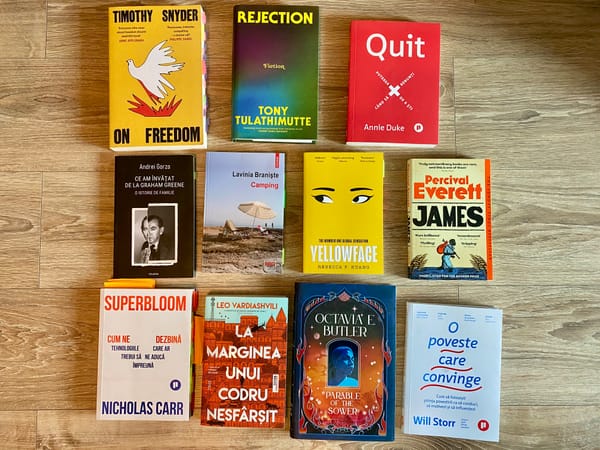
📚 Three amazing books that I read over the holiday: one is McEwan’s What We Can Know, which is also a meditation of what we actually know about others from what they seemingly overshare with the world. The other is Flesh, David Szalay’s Booker prize winner which I finished sobbing uncontrollably – maybe because loneliness has always been a fear of mine, especially as a man in middle age. And the third, speaking of history being done to you, is Lea Ypi’s magical Indignity, a re-imagining of her grandmother’s life in the first half of the twentieth century, escaping WWII-type fascism in Greece only to find hero-worship communism in Albania. (If you missed it, my list of 2025 reads is here).
🍿 I don’t have to recommend Stranger Things because you either watched it or are actively staying avoiding it. I’ve loved it from the very first episode almost a decade ago, and I watched the finale on New Year’s night, with tears in my eyes. This show has always been about exiting childhood, and that story has never failed to touch me.
🎧 As always, I put together a playlist of the songs that I had on repeat last year. It’s shorter for 2025: 15 tracks.