Draft Four: 45 lessons and ideas from 45 years
Yay, a scary birthday again! So I'll use it as an opportunity to share some life things.

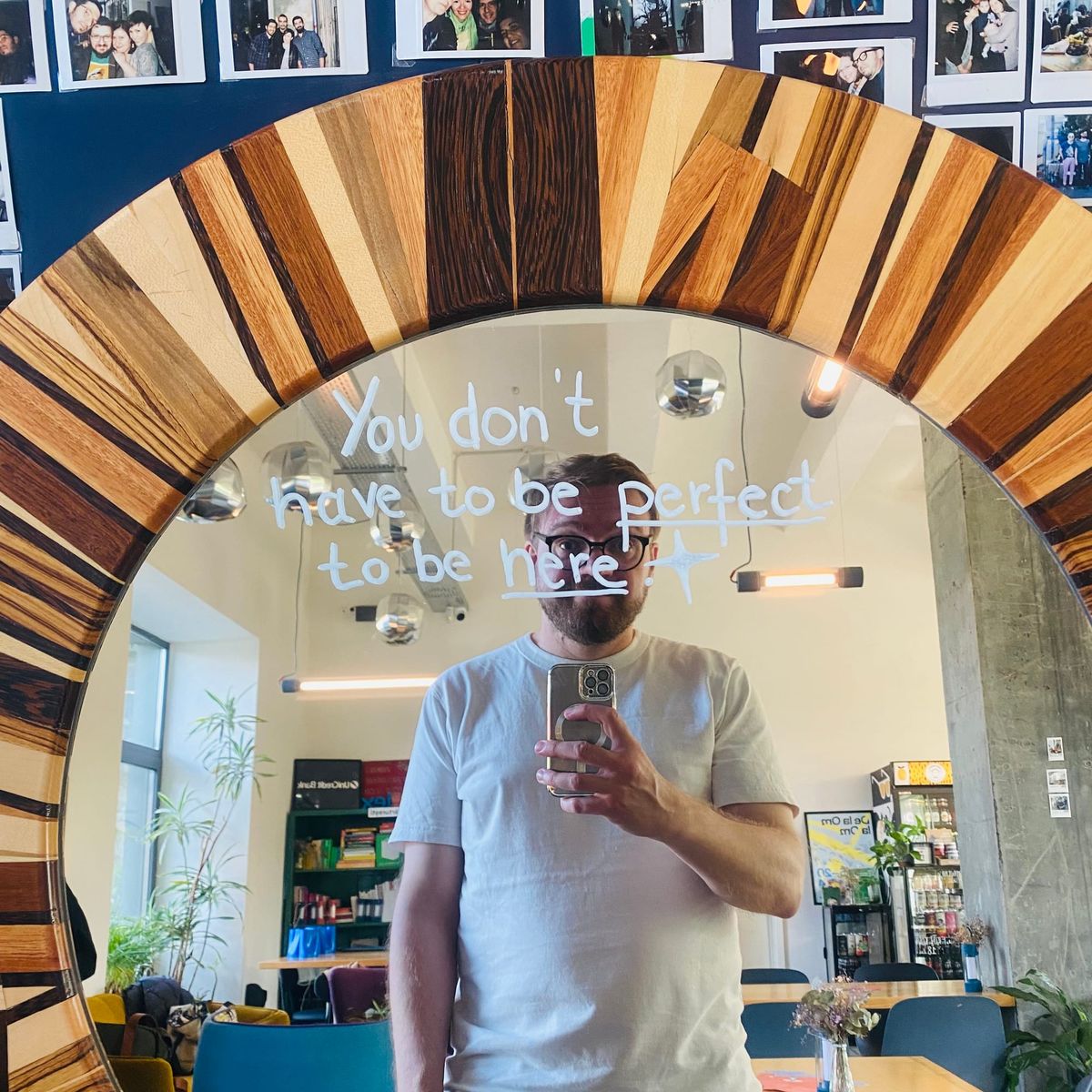
I am turning 45 on June 1.
Not old enough to be wise, but enough to have a list of principles, ideas, beliefs, routines and stories I tell myself to live. This letter is that list. It’s likely incomplete, and it’s not based on hierarchy, or topic, or ordered by type of insight. Some come from me, some come from loved ones or colleagues I asked to tell me what I keep repeating that is helpful. Most I cribbed from teachers, mentors, books, quotes or tools I tried over the years. I’m positive none are unique, but I hope they serve as a reminder – if not of a good life, then at least of an earnest attempt at it.
If you want to get me a gift, read to the end.
- We tell ourselves stories in order to live. We are narrative beings, and our superpower is narrating ourselves into existence and meaning every day. It’s a blessing, as it allows us to make sense of our place in the world. It’s also a curse, as it allows us to justify our own flaws, fears, and failures, and many of the injustices we allow.
- Think against yourself. We can’t stop narrating our choices, so we might as well challenge them. Am I really the one who is right? Is mine really the only truth? What if I don’t actually know much of anything?
- When looking to meet, offer a time. We get stuck in finding a time/place to meet – 1-on-1 or in groups –, because of endless loops of “when are you available?” or useless responses such as “I can’t Tuesday”. If you want to get together, be the one to offer options as early as possible; it always saves time.
- Give. You don’t need to earn my trust, you have it. Anything I know, I’ll share. If I liked something, I’ll tell the person who made it. Be a giver, not a taker. Of course it backfires, but it also shapes the world into one that feels kinder and more generous.
- Show, don’t tell. This is key writing advice, because the more specific you are, the more universal it feels. Don’t say you are “tired”. Say you woke up at 5am, after three hours of sleep, and needed two coffees to perk up. Same with team communication. Don’t say “our finances are not great”. Show the bank account with 4.000 Euros left in it.
- Failing to plan is planning to fail. There are numerous ways to encourage planning and discipline. It’s not for everyone, but I’m an anxious overachiever with people pleasing tendencies, so my life can veer off track without solid guardrails and planning. Which is why I say boomer stuff like “if it’s not on the calendar, it doesn’t exist”.
- Plan the hell out of it. Hold it lightly. Planning helps anxious people travel, organize events, even speak in front of others. But something will always go sideways. Problems should be expected, so get the comfort of a plan, and embrace the uncertainty reality brings with it.
- No coffee after 4pm. I tested this too many times. Find the limit of where something you enjoy becomes a hindrance. You can also call this the “One drink is enough” rule.
- Walk into your best thoughts. You can’t power your way to creativity. Sometimes you’ll stumble upon the solution precisely while doing something else. Walking is that something for me. Plus, I get my steps in.
- Write simple about complicated things. Someone said this as a takeaway in a writing workshop I taught about 20 years ago, and it lives rent free in my head. We’re not smarter when we hide behind jargon and complicated phrasing; just the opposite.
- Be humble.
- Reading is the best therapy. Venturing into other worlds, fictional or real, is the best empathy gym you can join. (Scroll for reading recommendations).
- The worst possible thing rarely happens. I often ask colleagues “what’s the worst that can happen” when they are worried about something. Why? So they can verbalize it and realize the chances of it actually happening are slim, so we might as well take a chance.
- The important thing is to show up. As an introvert, this is often my pep-talk to get out of the house. Show up with an open heart; it’ll be OK. (See #13).
- Don’t assume. You’ll make an ass of both u and me. Clarify.
- Journalism is a discipline of verification. My profession lives off of an inflated sense that objectivity exists, and that bias can be contained. I find it easier to lower the pressure and just do my best at running a disciplined checking process.
- Avoid first or never before or other superlatives. You are not the first event that does something. You don’t have the only product for something. You are not the biggest or the largest something. I doubt you checked everywhere (see #17) and even so, brag about the substance of what you do, not the context or the wrapping. (See #11).
- Culture eats strategy for breakfast. At work, at home, in your apartment building what you allow is the way things are done, no matter the rules on the wall.
- Quit things. At least quit better, as Annie Duke says: “Success does not lie in sticking to things. It lies in picking the right thing to stick to and quitting the rest.”
- There is a tension between real age and felt age. All of us have an internal age – I’m still 27 or 33 –, and a real calendar age. That brings about tensions with the world. Acknowledge and adapt without losing yourself.
- Upbeat sad songs are the best songs. This is one of my all-time favorites.
- Listen more, speak less.
- Loop people. This means asking people if you got it right. Don’t assume you got it right, and show you care: “What I heard you say is…”
- Get the sleep you need. Lack of sleep harms not just energy, but clarity, decision making, and, most importantly, health. I might not get my desired 7 hours every night, but at least I know that’s the benchmark I should hit to be at my best (for myself and for others).
- Hope is a choice. Chris Jones said this in 2025 at The Power of Storytelling, and we made it the 2026 theme. I’ve always operated from this point: the world is not doing great, but there are still things we can do. Let’s act and see where it takes us.
- Five minutes can be a lot. Best way to test this is to sit down and write to a prompt, without thinking too much. Se a timer for 5 minutes. Prompt is: “Recall one of your best meals ever”. Go. You’ll have a working draft. (Or do the same with your inbox).
- Storytelling is agency training. When we read, listen to or watch stories we are unconsciously looking for ways in which other people overcame obstacles: the death of a parent, heartbreak, losing a job, moving away from home, navigating a feud. Stories are simulations for the moment we’ll face a similar obstacle.
- You are not alone. Stories also remind us that we’re not the only ones going through something – whether that is teenage angst or acne, or adult austerity. Look for the one you need now; it’s somewhere out there.
- Imagine the best possible story. I always do this with reporters (hat tip to Jacqui!) What if we had all the resources we dreamt of? What if everyone said “yes”? What’s the maximum we can get? Find that point, then subtract based on constraints. You’ll always get a better outcome than if you start from building up from the minimum.
- Hell yes! Time is finite. As you grow and the demands on your time grow as well, this becomes painfully obvious. The challenge is to switch from a reflexive yes, to an intentional no. So if an opportunity is a “hell, yes!”, do it. If not, just say “no”.
- Don’t commit over the phone. This is a reminder to the anxious. I am more vulnerable over the phone to saying yesses I’ll end up regretting. I’ve learned to say: “thank you, I need to think about this before responding. I’ll get back to you.” You lose some opportunities this way, but you also reduce the chances of screwing over future you.
- You can control the quality of a decision, not the outcome. This is a version of trusting the process. Take in data, evaluate, pick a course, but don’t mistake the outcome for the process. There is a Hungarian phrase that captures it: Ez van, ezt kell szeretni. In short: it is what it is. Once you separate outcome from process you learn to enjoy the latter and put less of your self-worth in the former.
- Support local artists, events, shops, NGOs. Especially if you can afford it: buy the book, pay the fee, purchase the ticket, subscribe. Don’t ask for invites or freebies or assume others will cover it. Your contribution is an opportunity for others to do more of what you love to consume.
- Taxes are OK. Too much wealth exacerbates inequities – that’s not a just world. Taxes, whether on your income or on your company, are meant to reduce those inequities and fund public services for all. Don’t mistake the ideal social contract with flawed or corrupt execution. I know Romania is not Sweden, but that’s not an argument not to behave like it could one day get there.
- Perception is truth. Again, we are narrative beings. When someone believes something – even if factually false – that is their true story, that is how they organize their world and their decisions. Your fact-checking doesn’t stand a chance against a storyworld on the defensive. Live in this tension, and work around it. You don’t need to persuade in order to connect.
- Edit what you don’t see. When I read reporters’ work, I look for what’s missing, not just edit what’s in front of me. This goes for ideas and projects – don’t respond solely to what’s there, but also to what is missing or what could be added.
- Perfect is the enemy of good. I am all for hard work and believe there is such as a thing as excellence. But then there is also obsessive tinkering, and analysis paralysis, and a false sense of security behind believing “it’s not perfect yet”. It never will be. Do your best today. Deliver on deadline. Do better tomorrow.
- Coach, don’t fix. Many on this list are aspirational – this might be the one I still struggle with the most. Don’t take over the work of others if possible. Share how you approached such a problem in the past. Ask “how would you do it”? But try not to fix if you want to create space for others to grow.
- Give people the chance to reject you. This is a reporting lesson – don’t assume people won’t talk to you because they are important or grieving or have something to hide. Ask. Open yourself up to rejection. But don’t make the decision for them.
- Be curious. Ask questions about anything and everything. People and the world are fascinating and amazing.
- Even Greuceanu falls sometimes. A guy from high school once said this (while stumbling drunk at a party). Greuceanu is a fairytale character who put the sun and the moon back in the sky after they were stolen. Slay! Also, tough standard to live up to. If he falls occasionally, you can as well.
- Have a go-to curse. “May Hector fuck them!” (Să-i fută Hector!) is something my grandfather used to say when disappointed with people or life in general. I have no clue which Hector he referred to, or why Hector should fuck them, but I’m rolling with it. It’s versatile, and I added more characters to the list, just in case Hector needs a break: Terențiu, Cristobal, and Poloniu.
- Add habits to existing routines to integrate them. We all struggle with routines. What has worked for me is layering healthy habits on top of existing ones: for example, taking vitamins in the morning while the coffee brews. I always make coffee, which means it’s a great place to add something that helps in the long run.
- Courage is a series of small steps. This is from a Hungarian poet, and it remains a guiding light. Growing up fearful of the world, its pain, judgment and violence, my dream was always to be courageous in the face of danger. It took years to understand that courage, like life, is a journey.
- Do it as if that’s all there is. This is from something Jacqui Banaszynski once wrote – it’s about the purpose and soul of narrative journalism, but you can apply it to your own craft as it’s about doing something to the fullest and to the best of your ability. This is the full quote: “Stories are our soul. Write and edit and tell yours with your whole selves. Tell them as if they are all that matters. It matters that you do it as if that’s all there is.”
SIDE DISHES
Cărturești has been my go to Romanian bookstore for two decades. So having them sponsor a few editions of these letters is humbling. Cărturești is also the parent of AudioTribe, an eBooks and audiobooks division. It’s a great time to sign up for a test-drive because they are offering the first two months at 9.99 lei if you use the code AUDIO26 on this sign-in page.

They have some English titles, too, but most of the recommendations below are in Romanian translation. In keeping with the theme of this letter, I picked some books I’d always recommend. Give any of them a listen:
- Exhalation. (Exalare), Ted Chiang. Among the best collections of Sci-Fi short stories. Chiang is a big thinker, and every story is a provocation. My favorite in here is the last in the book, Anxiety Is the Dizziness of Freedom, a fable about freedom and accountability.
- Reboot, Jerry Colonna. (Available in English) This is a leadership book, but an unexpected one, as it deals with leadership as a force for growing up and becoming who you were meant to be.
- The Year of Magical Thinking. (Anul gândirii magice), Joan Didion. I first read this 20+ years ago, in a way preparing myself for that “instant” Didion mentions – the instant in which someone you love dies and everything changes. It accompanied me through my mother’s death, offering both solace and strength.
- Range, David Epstein. A love song to generalists everywhere. Epstein looks at the research to make a case for generalists in a specialized world. As AI threatens to replace jobs, this is worth returning to as a reminder of our range and capacity.
- My Brilliant Friend (Prietena mea genială), Elena Ferrante. Arguably one of the best novels of the past quarter century; hype well deserved. Start with this one but then go through the whole Neapolitan Quartet – it’s the history of a friendship and a country struggling to balance individuality and solidarity, tradition and freedom, love and envy.
BEFORE YOU GO
If you want to give something back after this letter, here are some suggestions:
- Buy a book by a local author, go to a show, donate to an NGO (you did re-direct your 3,5%, right? May 25 is the last day!), support an independent media outfit. And then tell them what they mean to you. Gratitude is underrated.
- Get a subscription like the one above or spend on something that will teach you something. Sure, I can cheekily recommend early bird tickets to next year’s The Power of Storytelling, but there are many other things out there that can inspire and teach.
- Help me offer seats at our conference to people who want to be there but can’t afford the cost (220-250 Euros for the two days). We dream of increasing the number of seats we give to NGOs, artists, journalists, students to over 50, ideally 100. Drop me a line if you or your company can cover the cost for some.