Draft Four: Monkey Mind on Scarcity
On (not) getting it together.

There are two main ways I use AI chatbots, which are relevant to my current predicament. (It’s still mostly ChatGPT without pay, although I have more issues with OpenAI than I care to elaborate on).
One way is as a thinking partner. Let’s say there is an issue I am struggling with, or a decision I’m trying to make, so I’ll write out everything – facts, assumptions, likely next steps etc. Then I’ll ask the model to synthesize my thinking, challenge, probe, or play a role (a wise editor, an inquisitive coach, a decision making expert). What’s useful is not any new info the model provides, but the way it accelerates my process, bypassing procrastination or avoidance.
The second is as a transcription machine. A couple of days ago I had two back to back meetings about potential partnerships for next year’s The Power of Storytelling. The second one ended around 6:30pm, and all I wanted was to go home. But I knew that if I didn’t leave my notes in order, I’d lose some of the immediacy of the ideas discussed. I didn’t want to type, format, arrange, so I turned to dictation mode, rambled for 5 minutes, and the output were my thoughts and notes, organized, formatted, readable by anyone. Again, it provided little novelty but allowed for efficiency.
And therein lies the rub.
I went to bed Thursday thinking about what I should write in this letter. I woke up at 6am on Friday, agonizing over it, fretted for more than an hour in bed, then got up, made coffee and dragged myself to my desk. My first thought was: Why is this hard? Can I make it easier? Oh, could AI help me pick a topic?
*
This is not a letter about AI, yet my desire to reach for a tool that made writing easier speaks to a few things. Without practice and less regular output, writing seems harder. I sit down with my head a mess of things – ideas, to do lists, worries, opportunities, responsibilities. This kickstarts a cycle of anxiety and agitation that just feeds on itself.
Clarity comes from focus, focus is a function of time, time is something you allocate, and when everything feels precarious and scarce, allocating time to yourself (!) feels like the riskiest thing.
At such times, we have a tough choice to make: we can turn to distraction or apparent efficiency boosters, or wade through the chaos with curiosity.
*
I’m writing at a time of great agitation, and I feel annoyed I can’t find focus.
I’m a month away from turning 45, so maybe that’s part of it. But more simply put, I’m overcommitted, under resourced, and too vigilant.
If you’ve been reading me for a while, you’ve already rolled your eyes. Just say it: you are always overcommitted and chasing everything like a squirrel. Guilty. But!
What’s different is that now, in 2026, I largely know what I want to do – build the foundation for The Power of Storytelling, assemble a core team to sustain it, run new experiments from that platform etc. But I have no money to assemble a core team (so I can distribute the work); I don’t have enough money to even cover the 15,000 Euros loss on the 2026 edition. (Read: unpaid bills).
This is my own privileged dilemma, but I see it all around me in journalism, creative circles, NGOs: you know what you want to do, what you want to build, but you need resources. Some resources exist. Since you’re not the kind of person to forego action, you chase those resources. Most are contingent on you doing something a little different than what you wish you’d be doing. You think that’s a problem for tomorrow. What matters NOW is that resources come in. So you spend time to apply, pitch, whatever. Yay! It worked! Now you have some resources, but you are committed to a different thing, and more time passes with you not building what you wished for.
I currently have three grant calls on my desk. All could bring some resources for me to cover some losses and grow the team. I have ideas that would fit all. Yet none of those ideas are my priorities. If our team of three FTEs decides to apply, this would mean not doing other things. And if we get them, we’ll have to deliver those projects while hope we can set some time aside for the actual plan.
If you’re an NGO or an artist, this is terribly familiar. You go to workshops, and they tell you about mission drift, and the dangerous spiral of going from grant to grant that seems a little like what you’re about, but not quite. So what do you do?
*
It’s an easier call if you are by yourself: just open up social media. It’s full of solo creators or freelancers lecturing you on how to ask for what you’re worth, how to say NO, how to get to do the projects you love. But that grind (or focus) is not for everyone. Plus, it’s lonely. Not to mention that putting yourself out there is easier for some than others – attention attracts resources, but not all of us are built to seek it in the ways that algorithms demand.
My brother recently told me he’s happy there is more of me on Instagram, mostly promoting The Power of Storytelling. Sure, I get it, a face helps, but in an ideal world I wish I didn’t have to do that. I wish I could just build the thing others enjoy and not have to sell and resell it every single day.
But this is not the time to “just build”.
This is the feeling that’s most haunting – the scarcity of it all, this sense that you’re running out of time, that you’re always playing catch up with the world, that you’re not where you’re supposed to be. Nothing seems enough.
And it’s not just a feeling. On some days, on many days, there really isn’t enough.
An amazing newsroom in Transylvania just announced they only have reserves to cover their salaries for May; June is in doubt. (Please donate if you can; I pitched in with 40 Euros).
I know how hard it must have been to say that publicly – I’ve been there. And the first instinct – my first instinct – was to write to them and suggest they do more to get attention for their plight. Or just hunker down and burn themselves out by writing proposals and pitches just to get out of the hole. But both of those would mean they wouldn’t be doing their job, which is telling stories about their community. And sure, you could argue that if their community isn’t paying, maybe the product isn’t worth it. But the community IS paying – it’s just not enough.
*
Enough for the people I am talking about – and I believe that many of you, dear readers, are part of this group – doesn’t mean a lavish lifestyle or excesses. It means just enough to do something that you love, which has long-term value, which creates memory, belonging, is a worthwhile experience.
Few people around me feel they have enough to live in Bucharest, which goes to underscore the point made recently by a business magazine: at least two cities are emerging. One is rich enough to remain unphased by inflation, price increases or rent hikes. The other is becoming more isolated, consumed by both real and perceived scarcity.
Journalists, artists, social workers, activists are, by and large, in this second group. They face personal scarcity, organizational scarcity, and their heads are a mess. OK, let’s not speak for everyone. My head is a mess. On my own, I’d be OK – I’m luckier. But I don’t like doing things for myself: I like not just building with others but helping others grow and reach their potential as we tell great stories or build cool experiences together.
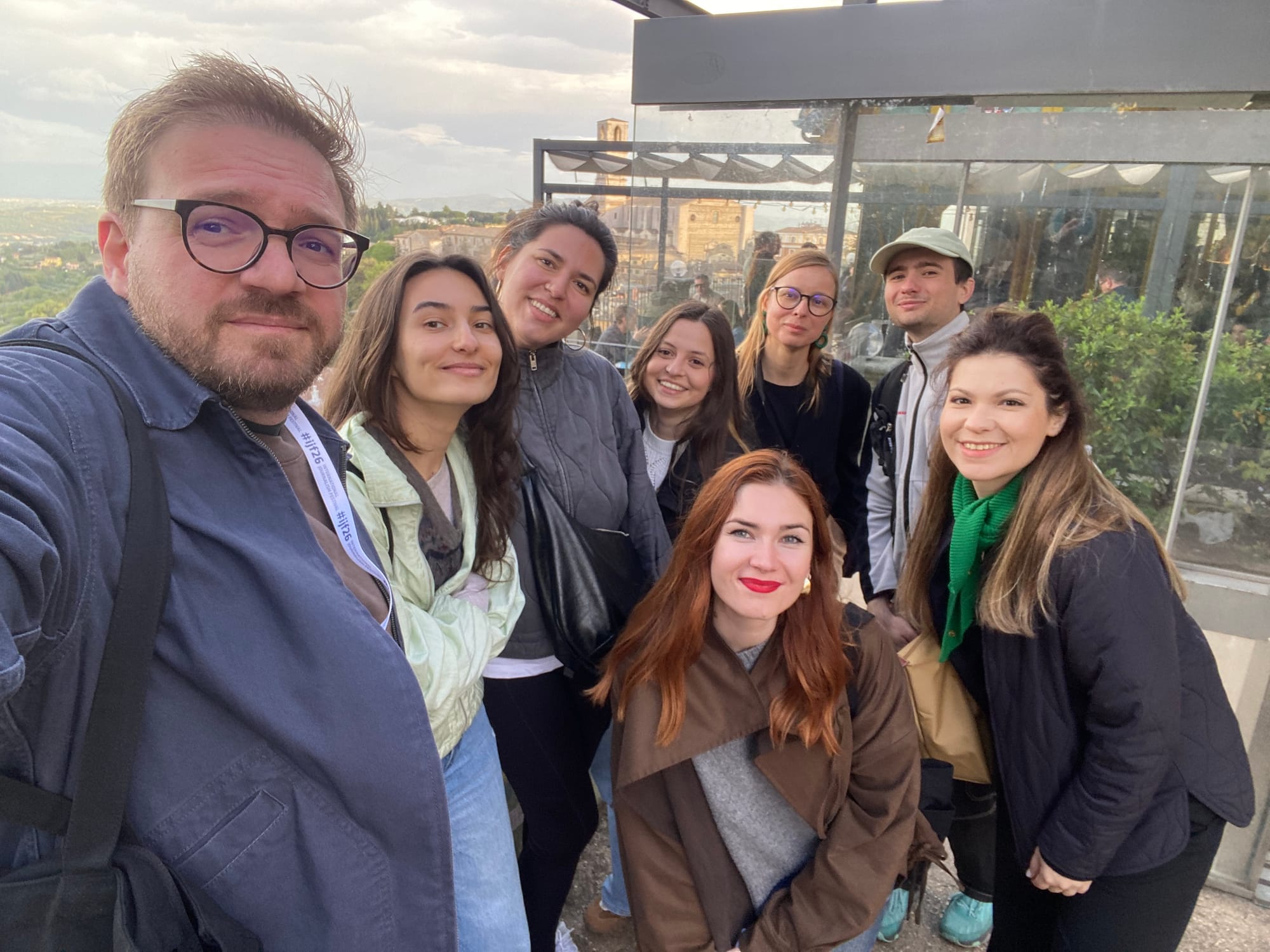
A couple of weeks ago I took some of the people from our team at The Power of Storytelling to Perugia, for the yearly International Journalism Festival. Realistically, we couldn’t afford it. (As I said above, we’re in the red after this edition). But what’s the point of being together when you can’t grow and learn and share a tiramisu?
In a way, I’m contrasting this to my experience building DoR, which started from nothing in 2009. For almost two years we met after our day jobs in coffee shops or bars, clocked in during the weekend, did meetings around my kitchen table or crammed in a rented room in a lawyer’s office. It was fun, but it was also costly. Doing the thing you love, building something you care about, takes sacrifice. In resource-poor environments like Romania, sacrifice isn’t just a romantic way of describing commitment and resilience and suffering in the name of a just cause. It means risking relationships, your mental health, your physical well-being etc.
I am the result of all these sacrifices – mine and those of others. Would I do everything again? Yes, in a heartbeat. Would I take others through working for years, for free, dreaming it’ll eventually click into place? No way. Would I recommend this to someone who is now 27? Not without a long lecture on costs.
*
This is the last part of the problem.
Scarcity should not be overcome with sacrifice. Caring, yes. Caring deeply, hell yeah. Risk? Bring it. Suffering here and there? Unavoidable. But not through a long-term commitment to not having enough (money to live on), to not being enough (for a partner, your friends, your family), to not being healthy enough. This is what building in Romania (or Eastern Europe / the Balkans at large) feels like if you’re not just chasing “market opportunities” or selling big numbers to companies that talk about “values” but invest in “reach”. Making it in our neck of the woods – if you want to print books, campaign for women’s rights, make art etc. – is either a part-time hobby you do after a full time job, or guaranteed burnout.
Such scarcity could be overcome with solidarity. Yet solidarity requires ingredients we can’t seem to procure or mix: listening, curiosity, sharing, willingness to sit through boredom or disagreement, all functions of presence, being there, being attentive, seeing and being seen.
Do you have time for that? Especially if it doesn’t have an immediate pay off? Does anyone?
*
Transcription, Ben Lerner’s slim and wonderful new novel, is about a writer whose phone breaks just hours before he is to conduct one final interview with his aging mentor. As he is waiting to start the conversation, which now he can’t record, the writer sees some poetry books on the table next to him.
I couldn't attend to the poems. I wanted – I needed to – check my texts, my email, to swipe and scroll and photograph, to frame and filter and archive, to share my location, etc., so as not only, not fully, to be where I was; since at least 2008, to be where I was was too much for me, or too little.
This speaks to me on so many levels.
Before writing, I would have given anything to not sit down and do it – hence the thought that AI could save me time and stress. I didn’t go there. I wrote what you are reading (and will revise before sending), and what resulted is this mediocre effort of a scarcity-challenged squirrel-brain. My thoughts are imprecise, my insights scattered, their utility fuzzy. I hate sending things out into the world like this. Alas, this is where I’m at, and I believe this is where many of you are at, too.
Not necessarily confused about your trajectory or mission or needs – although that’s OK, too – but overwhelmed by the feeling that your solutions and resources and decisions won’t match the scale of the challenge, and then too tired or monkey-minded to share the burden with others.
I understand these are all great problems to have since our houses aren’t being bombed or our country raided. But they are problems nonetheless, and ones we are wrestling with ways to attend to.
This is the trick that AI, our phones, or our chronically online lives are playing on us: they are exacerbating our feelings of scarcity, pulling us further into ourselves, away from others or what we should attend to, while seductively suggesting they might also hold the key: efficiency efficiency efficiency, the right thing to buy to change the game, the perfect personal brand strategy, the time-saving hack from the Gods, that one Golden Grant or Ticket.
But none of these are the solution. At best, they are part of an imperfect arsenal of tools we can use. At worst, they are a distraction from confronting the chaos. You being here allowed me (forced me?) to spend a few hours and couple thousand words doing so. Do I feel exposed? Certainly. Do I feel cringe? You bet. Do I have more clarity and ownership of the predicament? Yes.
*
I’ll end with this – something that supercharges everything (and you have your own version if you are reading this from another country). In Romania the government is about to crumble, and the dawn of a far-right party joining a new ruling coalition is upon us. That is a terrible story to live through, especially since we’ve been here before 90 years ago and it only ended after years of cruelty, suffering and bloodshed.
I’m not saying it’s where we’re going, but it is one possible reality. And the personal and organizational struggles I mentioned will be ever harder under these possible new circumstances, both because they might make pushing for progressive ideals harder, and because they might make escaping into distraction feel even safer.
Being in this space and time right now means facing chaos, stress and scarcity. And they have to be faced in sync with a political reality that could make everything worse. Fingers crossed.
SIDE DISHES
My friends at Cărturești know I love to recommend books, and they came to me with a proposal to be an ambassador for Audio Tribe, their eBooks and audiobooks division. Yes, AudioTribe is part of the Cărturești ecosystem, which is the main reason I said "yes" to this paid partnership. I am also testing "reading" in audio, which I don't usually do, and I'll report back.
It’s a great time to join me in trying because AudioTribe are offering the first two months at 9.99 lei if you use the code AUDIO26 on this sign-in page. (They have some audio and eBooks in English, too, but the recommendations below are in Romanian or in Romanian translation).
Sign-up and start with any of these:
- On Writing. (Despre scris), Stephen King. This is a beautiful book about what it took Stephen King to become a writer, plenty of sacrifice and pain included. It also has this amazing insight into the creative life: “Life isn't a support system for art. It's the other way around.” // Audio, in Romanian.
- 4000 Weeks (4000 de săptămâni), Oliver Burkeman. The perfect reminder, in book form, of how finite our life is – the only scarcity that truly matters. If we live until we’re 80, 4.000 weeks is all we get; how will we spend them // Audio, in Romanian.
- Singur. Viața lui Mihail Sebastian., Tatiana Niculescu. Sebastian was one of the more important cultural figures of the interwar years, one who never quite belonged. Depending on who judged him, he was not Jewish and religious enough, not Romanian enough, not loud enough. Yet he witnessed a generation blinded by fascism, and a country tearing itself apart – important read if we are to not repeat the same mistakes. // eBook, in Romanian.
- Ministry for the Future (Ministerul pentru Viitor), Kim Stanley Robinson. It’s been a few years since I read this Sci-fi gem, but it stayed me ever since for the portrayal of what Earth could become if we took the climate crisis seriously. Yes, it’ll require us to accept living with less, on less land, and not take everything for ourselves. // Audio, in Romanian.
- Flesh (Ce nu poate fi rostit), David Szalay. Last year’s Booker Prize winner is one of those haunting reads that stays with you long after you get to the end. If you’re looking to understand something about the hollowness of some men’s lives, Szalay’s book it is. // Audio, in Romanian.