Draft Four: Breaking out of storyworlds
Fragments and summer reading recs.

My previous letter was a list of ideas, thoughts and lessons on turning 45 (#39: Give people the chance to reject you). The one before that was about a feeling (and a reality) of scarcity. I was, I wrote, “overcommitted, under-resourced, and too vigilant”.
A few days ago, during a workshop, someone asked whether we’ll lose our capacity for stories that require time and energy, as we’re all subsisting on bite-size digests, reels, AI summaries, dopamine scrolls. We crave commodity, speed and novelty, both for the sake of perceived efficiency, and arguably to drown out those pesky persistent realities in the background.
The generous way of putting it is that we escape the war in Iran, the cease fire that is not a cease fire in largely demolished Gaza, the war in Ukraine now going on longer than World War I, the reality of the corrupt footballing body that is FIFA. Or locally, in Romania: month over month inflation hikes (leading Europe by far, and nearing 11%), a potential government to replace the collapsed one – seemingly apolitical but without a platform (at the time of writing), a judiciary that considers criticism from civil society and the media equal to a coup d’etat.
One way to make these go away is overstimulation: more work, investing in internet beefs until they balloon to epic proportions, and content, content, content. I’m as guilty as anyone and the unfortunate downside of this escape is that depth suffers, focus becomes elusive, clarity, a mirage.
This is not new, but it feels worse than it was around this time last year. This letter will echo this – consider it either a list of things my brain couldn’t find energy to go deeper into.
Can we design for introverts? I am a terrible small talker, especially in quick interactions or in groups. Mingling, networking, context switching from one project team to another, drain me. I recharge alone or in one to one conversations, I prefer listening to speaking, and care over competition in groups. But our environments are not built for introverts or for people who are more shy or anxious. Signage is lacking, information on how something will unfold is scarce, onboarding is a nice to have, barely anything runs on the announced schedule, workplace transparency is an alien concept, and the idea of holding space for all to speak makes some roll their eyes: if have something to say, just man up! Add the layers of a conservative, patriarchal and discriminatory society, and you have recipe for a humongous group of people not achieving their potential, because we don’t build for them.
Long live the novella. I have become a fan of “small books” you can read in one sitting (or a day). Technically, some are novellas, which means they can go to 30-40.000 words, which is around 150 pages. For me that is usually around three hours, maybe a little less on a good day. Looking through what I’ve read recently, here are some recommendations:
- On Earth as it is Beneath by Ana Paula Maia is fast-faced, and brutal, but can be an important meditation on what we keep out of sight (or what we bury).
- Everything Is Tuberculosis by John Green retraces the medical and social history of one of humanity’s most prolific killers. For decades it’s also been a disease we can cure, and still we choose (for “economic efficiency”) to let hundreds of thousands of people die.
- This is How You Lose the Time War by Amal El-Mohtar and Max Gladstone is an impossible to describe space opera. Let’s try it like this: two time-travelling agents that should kill each other, fall in love through correspondence. This is from the acknowledgements, and I loved it: “Books are letters in bottles, cast into the waves of time, from one person trying to save the world to another”.
- Small Things Like These by Claire Keegan. Read this gem of a book if you want to restore your faith in humanity. Here is what the protagonist – who uncovers a wrong and tries to make it right – thinks at one point: “[Was] there any point in being alive without helping one another?”
INTERMISSION: You can find some of these books on AudioTribe, the ebook and audio book platform of Cărturești, who backed the last three letters (this one included). Thank you! John Green’s is there, in Romanian. So is Claire Keegan’s in the Extra catalogue. And if you want some inspiration to write, you can find Stephen King’s superb craft memoir, On Writing (in audio form), along with arguably the best book about how stories accomplish their means: George Saunders’ A Swim in the Pond in the Rain (ebook, in Romanian). It’s a great time to sign up because they are offering the first two months at 9.99 lei if you use the code AUDIO26. (First seven days are free).

We’re blindly defending our storyworlds. Let me quote one my fave Sci-Fi writers, Arkady Martine, expanding the concept of storyworld – which describes the reality a work of fiction creates –, to how it also defines the territory of our real lives: “We can in fact imagine all of society as a storyworld. But my storyworld – my rules for how the world ought to behave – are different from my neighbor’s, who has had different experiences than me. The stories that make sense to my neighbor may be incomprehensible when I think about them, and vice versa. This is how fanaticism happens: how people believe things which are not true, even when they’re presented with evidence to the contrary. It doesn’t match the narrative. It doesn’t fit in the story. The world doesn’t make sense with this evidence, so the evidence must be wrong.”
The Romanian judges who believe media and civil society want to overthrow the system live in a storyworld. Those who think lefties are about to cancel everyone and take over Romania, a country so conservative that the social-democrats took out the word “progressive” from their charter, live in a storyworld. But so do I. So do you. And what doesn’t fit with our storyworld, or worse – what can be claimed by multiple storyworlds (our Cannes-winning movie, for example) – doesn’t match the narrative, so, for order to be restored, it must be discarded.
But there is another way. I loved this conversation between Ezra Klein and Yuval Noah Harari (they’re not welcome in some people’s storyworlds, but they are part of mine). They touch on many modern ills, from Trump, to the genocide is Gaza, to AI, and often through the lens of story, positing that flourishing ultimately requires cooperation. This means we can – and we have, historically – traded the language of war and exclusion with one of belonging. Here’s Harari: “The mind can hold on to stories with extreme force and violence but then let them go. Because ultimately, again, it’s a story. It’s not the laws of physics. It’s not a law of biology. It’s just a product of the human mind itself – which is very good news. (…) Under certain conditions that we don’t really know how to create, people can let go of these stories.”
Pain vs. suffering. I have another one from Ezra (what can I say, he’s had a good run), that summarizes another story challenge we face: separating facts from interpretation. In this episode he talks to the Buddhist teacher Pema Chödrön, and they have a simple explanation for the difference between pain and suffering. Pain is my back aching from lifting a washing machine earlier in the week without being careful. It’s factual. But the mind loves story lines, so it might go, and I’m quoting Pema here: “Oh, this is going to get worse, and I’m going to be disabled. Or: I’m not going to be able to do my work because of this. Or all sorts of disaster scenarios that are causing so much suffering. That’s optional, that part.”
How to be with an experience without loading it with story lines? You sent an email, and there is no reply. Why should you think it’s ghosting? Your boss said the project is moving slowly. Why would you think they are blaming you for it and burnout will follow? Your coffee just got more expensive. Why would you think they’re stealing?
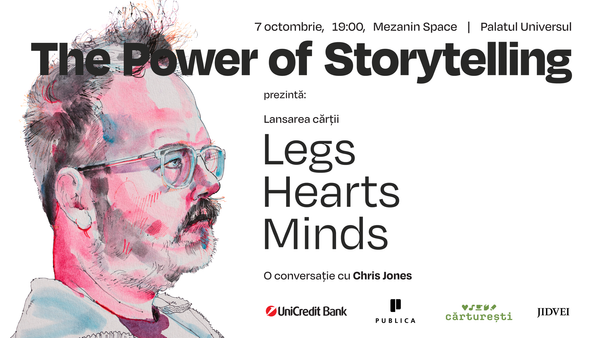
Legs Hearts Minds. This is a football mantra from a British coach, but it’s also the title of Chris Jones’ beautiful memoir; just released. Chris is a long-time and frequent guest at The Power of Storytelling, and this book is a perfect read during the World Cup. (If you want to wait for the Romanian edition, it’ll be out in October). The book starts with Chris, 42, his marriage crumbling. To heal that wound he leans hard into rooting for the English club Burnley, a family tradition. Football is memory, and love, and it all seems fine until new tragedies strike (another break-up, a mother’s cancer) – and this is where the mind’s ability to fight doom & gloom kicks in. It all hit very close to home (and not only because our event features in the book), and I might have a cried a few times while reading. Those who saw Chris speak in Bucharest will know the feeling.
SHAMELESS PROMO: Early bird tickets for our 2027 edition of The Power of Storytelling in Bucharest are out – get them HERE . (Next week we’ll announce local editions in Iași and Timișoara, taking place in October).
MORE STORIES. It’s said we read to know we are not alone, and that storytelling is agency training – meaning it prepares us for overcoming obstacles. We recently awarded this year’s winners of the European Press Prize, in five categories. It was my sixth year as a judge, and fourth as the chair of the selection committee, and to me these stories show that journalism still holds space for complexity, context, and for human experience. It remains a source of understanding, accountability, and, in some ways, hope.
We had stories out of Gaza, Ukraine, and Syria, stories that covered the costs of war, child abuse, government corruption, or surveillance overreaching. We also had beautiful pieces that asked questions about grief or loneliness, our reliance on algorithms, and our ways of making memory. Here are three that stand out:
- What the Wounds Are Telling Us. Based on interviews with 17 doctors who worked in Gaza hospitals, it shows evidence of more than 100 instances when the Israeli army, through snipers and drones, deliberately targeted children. What the wounds – in the head, or in the chest – tell us is that violence upon Gaza’s children was not a gruesome byproduct of the war, but a planned part of it.
- Why Men are Losing Friends. A piece out of Slovakia on wrestling with traditional gender roles and the toll this takes. Writes Filip: “A child of only 12 or 13 years old understood the unwritten rule that ‘real men’ keep an emotional distance from their mothers, whom they still need very much. Already as children, we learned to pretend that we don’t need each other. The saddest thing is that many of us believed it. We can’t even imagine how much we are losing.”
- The Brother D Conspiracy. This is a story that The Irish Mail has been working on and updating for more than a decade. It charts the cover-up of the crimes of a serial predator, who abused children for decades, from Ireland to countries in Africa, where his Catholic Order sent him (instead of dealing with his crimes). It shows, among many other things, the importance of focusing on something until you can make that something a tiny bit better.
I wish us all a focused summer.