Draft Four: Hello strangers
On finding one’s inner home.

As I sat down to write I looked up the definition of four different words. I want to be as precise as possible about what I have been feeling recently, without an exact moment to point to for blame other than the general heaviness of the world.
Discouraged means feeling less confident or enthusiastic about doing something. You’re still committed to the goal, but it’s harder than it seemed, and motivation has slipped.
Dejected means being low in spirits. Something has happened, you have suffered a defeat, and you just want to retreat and lick your wounds.
Disheartened is having lost hope or confidence. Some of your belief in something has fallen away, your enthusiasm for the cause is more or less gone.
Despondent is being sad, without much hope all. You don’t see how anything could get better.
Arguably depressed would be next on the list, with little light at the end of the tunnel.
In conversation we might use them interchangeably, but precision matters, because it charts a path towards the future. Me personally, I am in a tug of war between disheartened and discouraged, and I’m leaning towards the latter, with more of a dip in motivation than belief, yet carrying an overwhelming sense, as the band Editors puts it that “is gets heavy for everyone”.
To be honest, I could list some reasons for this. Financially, it’s tough to run a small organization that has, at its core, a storytelling festival that costs a lot of money to put together, all in a time of financial crisis. The costs are so high because the experience is meant to be special and fulfilling, which means travel, hotel, meals, participant hosting are prey to the inflationary spiral of the past few years. Personally, the toll of trying to balance everything has once more severely cut into my space for thinking (and writing): if this newsletter was a blessing just two years ago, today it feels like a burden (though no fault of its own). Socially and politically, the sense that my country is slowly driving itself over a cliff while we’re focusing on minor details on the side of the road is sometimes overwhelming.
Maybe the last has been the most nagging thought, and it’s been hanging heavy for a week, since I read a book on Mircea Eliade by one of his students (the link is to the Romanian translation). Eliade is a set up as a towering figure in Romanian letters – a scholar of religions, a thinker, and a prolific writer. Ye he was also a fascist, and explicitly anti-democratic in his youth, and he never addressed his far-right allegiances after leaving Romania during World War II (he died in Chicago, in the 1980s). People have mounted innumerable defenses and excuses since but he himself hasn’t said much aside from signing a paper once, at the pressures of the state, thus guaranteeing him the flourishing future he then enjoyed.
That’s not new, and neither is much of Bruce Lincoln’s Secrets, Lies, and Consequences. But the radicalization of much of the Romanian intelligentsia in the interwar period came sometime between 1926 and 1939, with Eliade and his Gen ’27 peers leading the charge. Just say the words “Generația 27” and tell me you don’t feel a chill – we are there again, with history in the balance. (Just look at the elections that will sweep Europe next year, from France, to Italy, to Poland).
*
A few nights ago, an earthquake shook Bucharest enough that the furniture in my house trembled. It was one of those 3am moments where one realizes how vulnerable everything is: a building, a city, a routine, a country, a life.
Every earthquake brings back the prospect of 1977, when a lot of downtown Bucharest crumbled, more than 1,500 people died and 10,000+ were wounded, and the city has never been the same. This is why reading the book brought back echoes of a not so distant past: as much as your social media feed might warn of an international socialist takeover (with its own media darlings and its own streamer proletariat), the threat of a rightwing ethno-nationalist is greater (at least as a numbers game). And, in Romania’s case, sprinkle on top of the nationalist cake our particular spiritual and mystical and orthodox layer: a conception of Romanian identity that intellectuals like Eliade sympathized with and that the violent Legionary movement turned into political theology. The idea was that “Romanianness” had a unique spiritual essence, rooted in faith, soil, sacrifice and national destiny. The implication was that this essence was somehow incompatible with the liberal democratic order of rules, institutions and checks and balances. Their Romanianness was soil, prayer and vibes.
Now think about this the next time you enter a bookstore: be patient, look around, and then start counting books by priests, spiritual leaders, shamans, healers, or self-proclaimed gurus in touch with the Romanianness of it all.
*
I look for a home in words, and in these discouraging times I stumbled on Ece Temelkuran’s deeply moving Nation of Strangers. Temelkuran is an exiled Turkish journalist and writer, but this book is less a critique of her country’s authoritarian slip, or an indictment of fascism creeping into everything (although both are pillars of the work). This is more the account of a writer without a home, trying – in another language no less – to get her bearings and find a new kind of belonging, one less rooted in place.
Where Temelkuran lands is on the idea of being a “stranger”: “When you are a stranger, you are both in and out. You are there but not really. You are nobody yet have the endless possibilities of being anybody.” This is who she is now, and the nation of strangers is her home. And it’s home for many of us, too.
“Stranger, as an idea, immediately includes all those to whom our time seems too strange to become complicit in its monstrosities, all those who feel somewhat homeless in this world at this point in history.”
Part of what is strange is what led me earlier to find the precise word to describe how I feel: things are nowhere near lost, and I am far from losing hope. (This has been our Power of Storytelling 2027 theme after all – hope as the necessity for action). But it’s also nowhere near rosy, and I don’t want to pretend otherwise.
But Temelkuran is a much better writer, and I’ll let her paint the whole picture.
There is a sense of mourning in the air. It is thin still, but it is real.
It is as if we are mourning not for what we have already lost, but for what we know we eventually will. For the first time in history, humanity is mourning in the future tense.
All that is beautiful has not vanished yet. We still have things – lemon trees, the Mediterranean shores in spring-time, tipsy Sunday afternoons, a bit of the rule of law here and there, and many brave women who are still loud enough to become the nightmare of fascist leaders. The joyous, wondrous and magical are still here. But for a while now, it is as if a layer has been added to our retinas, an overlay of melancholy. Our eyes already sense it; everything that is beautiful has its future loss imprinted on them.
Still, we work, we act, and we even resist. But we know. Our basic joy and faith in life have been worn out. It is as if we all imitate our previous selves, which once felt at home in time and space.
A specific ache has taken over our times. We are all a bit like children – not called home, instead locked out in the cold, alone with the beasts. Every beat freezes the heart. That is why many, too many of us, decide every day to turn ourselves into unfeeling creatures so that we can function as survival automatons. These times are orphaning all that is humane. An uncaring world is in the making, and it will unhome humans like you and me.
This brand-new melancholy is the ache of losing home.
*
I don’t have a cure to the melancholy Temelkuran brings up. I guess I’m just trying to live through all of this, alternating between discouragement and naïve daydreaming, using stories to both keep an eye on the world, and to escape from it.
One of the paths I took to escape in the past year was through editing a book by my friend and former colleague, Anca Iosif. Anca is an environmental reporter who spent years writing about the relationship between people and the world around them. But she has always been interested in more than the facts of climate change. She is curious about what happens to us as the world changes and decays.
Anca herself wasn’t seeing much to celebrate and it got her past discouragement – maybe even into despondency. As she said recently:
“Somewhere along the way, I got stuck in a barrel filled with worries about the future and regrets about the past – some bad decisions, unfinished conversations, too many things left unsaid. I was feeling so sad about myself being sad, if that makes any sense at all. No part of me was living in the present.”
Her personal cure? Walking.
“Walking was the only way I knew how to shake off these moods, at least temporarily. My 700 km became a separate room for thinking, slowing down and calming the voices in my head. I needed that room so badly.”
The 700 kilometers she references are the second half of Via Transilvanica, a road she began walking in 2021. A month on the trail gave her plenty of time to think about the things many of us have been wrestling with lately: the erosion of our sense of control, the pressure of other people’s expectations, the tension between wanting to be alone and wanting to belong.
Her journey became Împăcare (Making Peace on Via Transilvanica), a book that starts with a walk across Romania and gradually becomes a conversation about how we can and can’t live together.
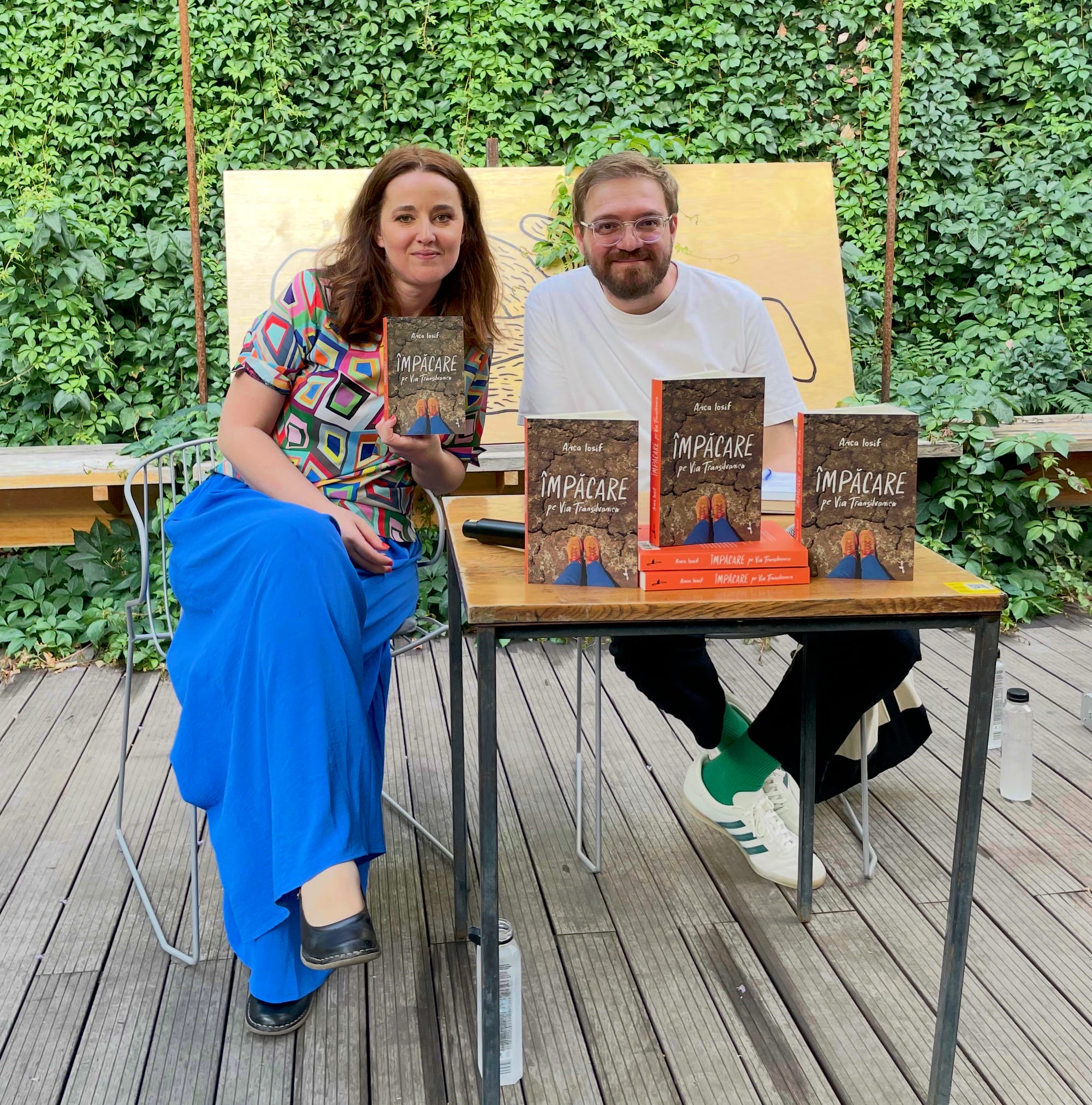
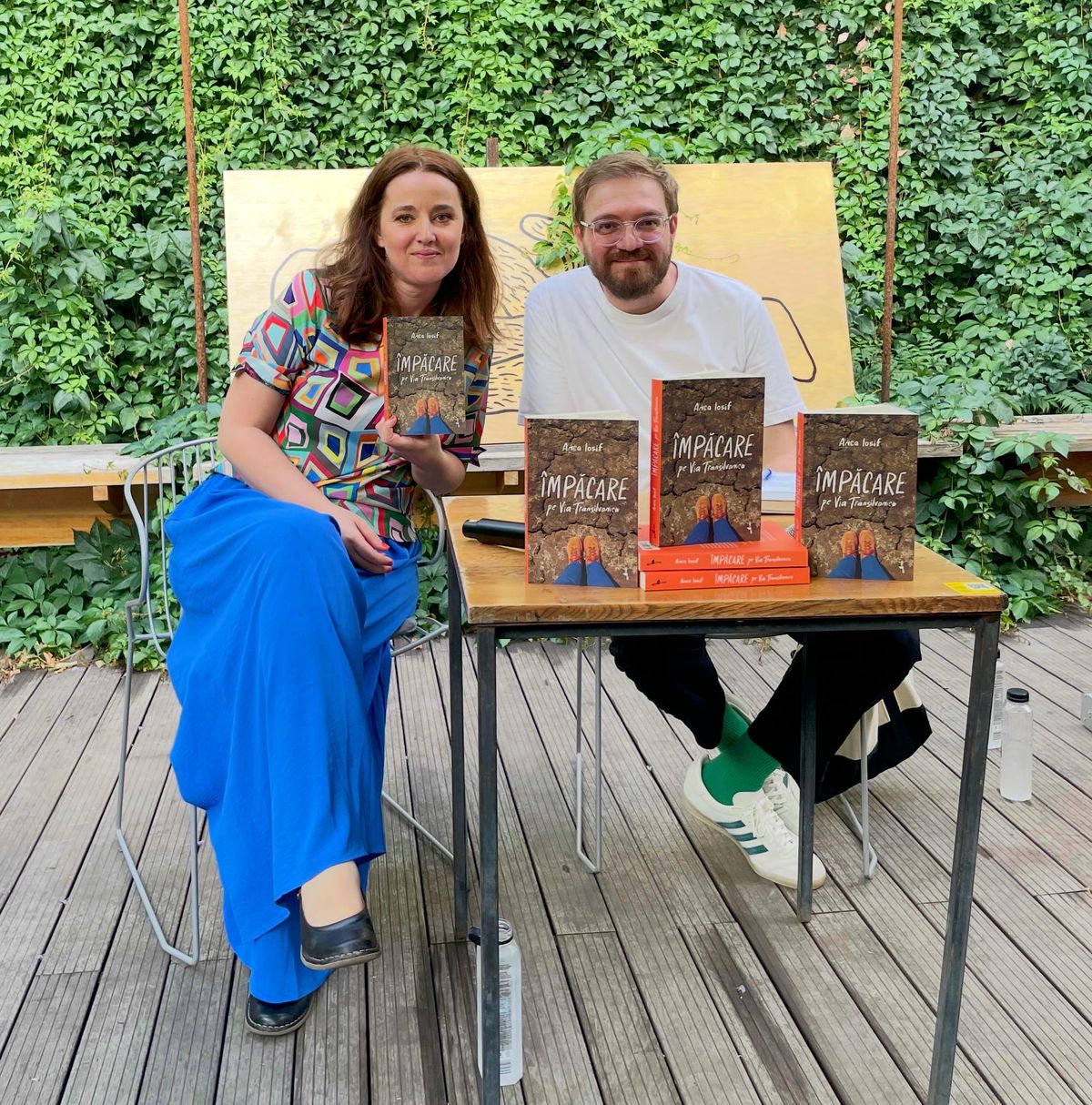
This photograph is from the book launch in late August, when Anca and I had a chat in the garden of Cărturești Verona in front of almost 100 people. Hundreds more have since picked up the book and were surprised to find something of themselves in it: in the journey, or in the questions accompanying it.
If we are a nation of strangers, then Anca is one of the strangers traversing our lands with the courage to show up and knock on our doors.
You can read the book, or you can listen to Anca read it on AudioTribe – a rare and special treat. (There is a 7-day free trial on the latter, just so you know).
*
I usually close these letters with a list of recommendations. I have another selfish one to follow Anca’s book, plus some news.
The selfish recommendation is a plug for the 2027 edition of The Power of Storytelling. HERE is our theme, and I believe it fits this moment – both the fractured attention aspect of our lives, but also our attempt to find or regain footing in place. Oana Barbonie delivered an amazing visual identity to accompany the theme, and the first speakers we announced are amazing. They include artist Dan Perjovschi, writers Tatiana Țîbuleac, Monika Radojevic and Rumena Bužarovska, and many more. (The full list is coming in January).
The news is that I will be sending one last edition of Draft Four before the holidays – arguably the last one for a while (if not ever). I don’t feel I am delivering the product you signed up for in 2023 or 2024 and even paid for at some point (thank you!); going from 50 letters a year to less than 10 is a sign that I should quit on purpose rather than simply fade into irrelevance. Also, judging from the little reactions I have received to the letters over the past year it’s also clear that they are either not landing, or are not the right fit for your habits. I always mumble at sports figures they should stop while they can play, so I’ll retire Draft Four, but we’ll meet in other forms, certainly at The Power of Storytelling.
Don’t be a stranger.