Draft Four: Loss and its remedies
What I learned from translating a book (coming out this October).


Hi, all. It’s been over three months, I know.
I’m so nervous to be writing a Sunday letter again that I anchored it in a subtitle I cribbed from Legs Hearts Minds, Chris Jones’ beautiful memoir about grief and the (unexpected) healing powers of giving your love to an underdog English football team named Burnley.
Chris is a longtime friend, and longtime guest at our annual storytelling gathering in Bucharest. He is also a dogged reporter, and a writer devoted to the craft, and to getting the most out of every sentence. Legs Hearts Minds is his most personal story, as it opens with him, at 42, out of a job at Esquire, a magazine he loved, finding out his wive is having an affair with a man he thought a friend. You can probably tell where this is going.
As Chris writes:
Three months earlier, I had lost my job. In the span of twenty minutes, I had lost my wife and my best friend. In the coming weeks and months, I would lose my house, half my money, and some equal measure of my boys. That wicked morning, that terrible dawn, I watched the sun peel back the longest night of my life, and I felt my anger already making room for sadness, fear, disbelief. I was forty-two years old. Nothing true of my life would be true again.
I lead with this to (partly) justify not writing for a while. From mid-June to mid-August, part of what I did was work on Chris’ book – close to 100 hours of translation into Romanian, plus revisions, my first adventure of this kind. It’ll be out in the next couple of weeks, so keep your eye on announcements from editura Publica.
(Two dear collaborators had my back. Adi, who, alongside me, features in the book when Chris mentions his first to Romania, helped with a read on the opening chapter. And Alina, my partner in crime when it comes to the line-up and program of The Power of Storytelling, read and edited the whole thing, saving me from clunky Romanian, and also fixing blatant errors of understanding. Thank you!).
*
The translation – as time consuming as it was – was not the issue. I decided to do it line by line, no machine translation to help, because I wanted to spend time with what Chris was building. Yes, it’s a memoir, and the facts are the facts, but how you present yourself as a character, when you reveal backstory, how you build to a moment of revelation, that’s not magic. It’s just a master storyteller using his craft.
This means I took in the story more slowly than I did on a first read, including its tougher parts, and Chris’ sobering meditations about ambition, love, mental health, anxiety, depression, fandom etc. I’d lie if I said much of it didn’t feel familiar. As a matter of fact, Alina gently prodded me: Is this hard to translate? Does it hit too close to home?
*
It did often hit close to home.
When I turned 42 in 2023 (Draft Four launched that same year), I had come out of a relationship that defined much of who I became as an adult. I was also out of a job, having shut down the magazine I had built for 13 years, and which had become the thing people knew me for. I then moved apartments, choosing something I believed at the time was just fine. In Legs Hearts Minds there is a lovely scene when Chris finds a place to move into after separating from his wife: a way smaller house, that can barely host his two boys when he has them, with coyotes howling outside the door at night. To him, it’s a sign of progress, of choosing things on the road to recovery. To his friends, it’s an emergency and a reason to text and check in: “Hey man, are you okay?”.
I didn’t lie to myself that things were going great in 2023, but I also didn’t surrender to the grief. Each of us tackles life in ways that match their temperament, their values, or the way they were brought up. My mother was an oncologist, and she would come back from work and share anecdotes about families who stood in her office asking questions such as: “Will our father get to see the first snow of winter?” My father was a brain surgeon, often spending a dozen hours with his eyes glue to a microscope as he removed tumors from people’s brains, people who would then make his phone ping at the holidays with thanks they were still around.
I don’t think they taught me this explicitly, but what I picked up is something I’ve come to believe in: pain, loss, heartbreak, disasters, are inevitable. The best we can do is acknowledge them, fight what we can fight, and adapt to what we can’t. Grief is real, grief is important, grief should take space. But so should life.
*
What Chris does so aptly in the book is point out how light sneaks in through dark times.
He notices it, and he allows us to bask in it. Some of that light is serendipitous, like unexpected love. Some is necessary aid, like a wise therapist or a local policeman who went through a similar phase and told him how the next few years will unfold. And some of that light is the result of a choice of where to invest your love – in Chris’ case, the underdogs of Burnley FC, the club his working-class English grandfather supported, which, at the time of Chris’ story, is coming and going from the Premier League. (He writes: “Without somewhere else to put my love, football became the most important of the most important things.”)
Part of what I rediscovered in the past five years is my love of football, mainly of the stories it carries and the memories they create: Messi’s last last World Cup, the oddball genius of a Michael Olise, the Italian miracle of Como, the Romanian great coaching Inter Milano, Pep Guardiola being Pep Guardiola, you get the point. It rekindled by playing Football Manager again, something I used to do in the 1990s. When I started again in late 2021, and continued avidly through 2022-2025, it was clear to me this wasn’t just a fun pastime.
It was existential.
My professional life felt in shambles. Money was tight, I felt lonely, I disappointed people, people turned on me, outside forces – like pandemics, wars – did a number on our plans etc. It felt chaotic and never-ending. Yet, in Football Manager I had some control. I took over a struggling Napoli side and made them Seria A champions (they since did that twice in real life). Champions League glory followed. Jude Bellingham and Kai Havertz retired from there (because I played till the late 2030s). I did the same with an unknown Romanian club, CSS Dumbrăvița.
Yes, the game was fun. But what was more important is that I could pour energy into a place where, even when something didn’t work, I could go again. It’s what makes games beautiful: you get to go again.
*
But you get to go again in life, as well.
This is what Chris is writing about, and it’s not a book about choosing yourself, finally going on that diet, embracing your energy, manifesting your dreams, whatever. It’s simpler – and thus maybe more difficult to put into practice – there is darkness, and there will be light. And once you have been through both a few times, you know one follows the other, so you trust the journey, choose hope, and go again.
Healing is not winning. It’s keeping going. And, most importantly, in football but not only:
There is a difference between wins and a winning streak, and it was dangerous to mistake one for the other. Teams leave themselves open to counters when they attack. Catastrophe happens when they confuse a signal to consolidate with permission to expand.
When I turned 45 in June, it felt awkward, unsettling. I made a lot of remarks to my partner about being officially old (yes, light!). Beneath the jokes was real anguish – it is the age range where a spurt of getting older happens, science says. Meaning you age more around 44-45 than before, so as to better inhabit the middle age you’re in, I guess. (The other moment happens at 60.)
The tension I felt came from simultaneously believing the worst of the past years was behind me – I had moved into a better apartment, in a greener neighborhood, I felt loved, I was once again doing meaningful work. Yes, Romania remains a shitshow (that’s a story for another day), but at least I was balanced. Can I just take the win?
*
Thank you, Chris, for reminding me that winning is relative: something always happens, and you will lose again. We are storytelling animals, so if we’ve conquered an obstacle or simply negotiated a truce, we’ll find another obstacle, or it’ll find us.
This is where Burnley comes in. Supporting a small club means years of training in handling disappointment. The best you can hope to do is trip up the opponent that is supposed to win. Some seasons you do that so well that you become a force. Those are the seasons of dreams. As Chris rediscovers Burnley, they have a few of those: they torch through Championship opposition, they go up in the Premier League, they stay up, they qualify for European football.
Chris’ journey mirrors that of the team. His hopes for his life, for his happiness, are tied, in a way, to a club he loves deeply. But when you look at the history of a club, you know: highs are followed by lows. So of course Burnley go down again.
As part of finding football again, I found my way back to the foreign club I supported as a kid: Manchester United. I grew up with the Class of ’92, a generation of teens, basically, that dominated football for the next decade and beyond: David Beckham, Paul Scholes, the Nevilles, Nicky Butt, Ryan Giggs. When one evening in May 1999 I watched United turn around a one-goal deficit in added time to beat Bayern Munich 2-1 and win the Champions League (and the treble!), I was hooked. This is how the frightened teenager about to graduate from high school wished he could be in life: someone who doesn’t give up until the whistle blows.
I started paying attention again through 2023, 2024, but the United of the past decade struggled. They had more lows than highs. And people loved to see United suffer after years at the top. Then, on an April night in early 2025, they pulled off a 1999 moment, and I was hooked again.
It was the second leg of a Europa League quarterfinal against Lyon. The first game ended 2-2. This one started well – 2-0 for United at half-time. Then Lyon came back to equalize, and extra time followed. In the 110 minute, Lyon had made it 4-2. Then Bruno Fernades scored from a penalty and in the 119 minute, my favorite player of today’s United, Kobbie Mainoo, made it 4-4. A minute later, a header from Harry Maguire won it. NEVER. GONNA. STOP. This is how the club titled the YouTube highlights reel.
*
This summer, as I was translating the book, United were gearing up for their first Champions League season in a while. They had finished third in the Premier League and in Michael Carrick had found a calm and composed new manager, who was two months younger than me.
I found it funny how easy it was to match your life to that of a football team. Chris knows all about that:
Burnley were a distraction, they were a bracing one, each season another dress rehearsal for life’s more meaningful disappointments. (…) It’s true that football is a game of dreams. It’s about who you want to be. It’s also a game of pragmatism. It demands that you know who you are. But football, maybe more than anything else, is a game of memories. Football is a game that helps you remember who you were. It insists that you do.
It turns out the tension I felt when turning 45 wasn’t for nothing. My June blood test showed my cholesterol levels were high again, so I had to go back on the medication I stopped taking because it made my muscles ache. The lower dose works better thus far. Then, the dermatologist told me my skin was naturally aging, which explained some bumps on my forehead, and then decided we should surgically remove a couple of odd looking moles from my legs for a biopsy. Fortunately, nothing, but throughout August I had to keep dressing the wounds, and I couldn’t run.
United started this season by losing to newly promoted Hull, and I scheduled more medical check-ups, as one should. The weird bump on my head turns out to be a benign cyst, but it’s better to remove it. (That’s how you start planning for 2027). And then, the cardiologist welcomes me to my first ever consult and sends me home with instructions to take my blood pressure twice a day for two weeks to check whether I simply panicked in her office, or if there is something to the high numbers.
United drew Everton, conceding in the last minute, then lost to rivals Manchester City, and on that night, two weeks ago, my blood pressure topped 160/110. The doctor was right – it turns out I am a mainstream Romanian middle aged man, suffering not just from high cholesterol, but also from hypertension, “the silent killer” as it’s lovingly known.
*
Translating Legs Hearts Minds was indeed the perfect summer mission. It allowed me to revisit these past few years, to look at the inflexions points, to marvel at how life changes while you’re sometimes too busy to notice, but it also reminded me that adapting to the setbacks is the sanest way to go.
We go again, yes. But we don’t do it over again. We live something new, something slightly (or more substantially) altered, and make the most of it.
As I write this, I am on my third day of hypertension medication. I have been making lifestyle changes for a while, too, but remember – I am the child of doctors, and I tend to follow their lead. I wish sleep, and good thoughts, and exercise, and the right vegetables and vitamins could cure all, and I’m on board, too. But those cholesterol pills helped, so I’ll take these other ones as well.
Hopefully Manchester United can at least go into the international break with a win. And then, we’ll just live and see.
*
Yes, there are a couple of announcements, too.
Chris Jones will be in Romania for us to launch this translation.
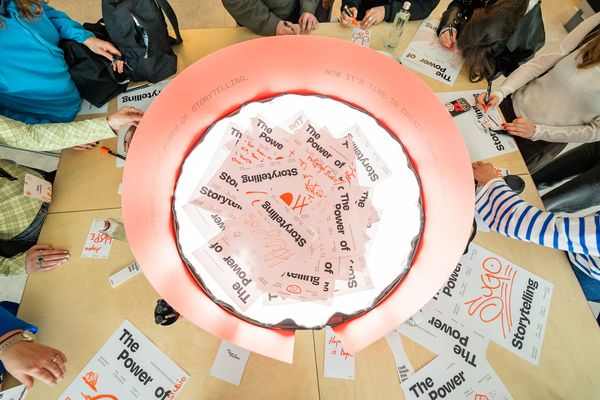
We are taking The Power of Storytelling to Iași (Chris will be there on October 4), but also to Timișoara (we’re coming without him on October 25), so if you know people in those cities, tell them we still have spots available; tickets are here.
And, on October 7, we are going to launch the book in Bucharest. Chris will do a reading, then we’ll talk a little, and we’ll end with drinks and Chris signing books. This is a ticketed event so grab yours now.

See you next week! (Yes, that’s a promise that I’ll write another edition in September).